|
|
|
|
Original Article
A Critical Review of available Infrastructure, Policy Frameworks, and Organizational Culture in the Implementation of Fairness-Enhancing Artificial Intelligence
|
Gyani Ray 1*, N Molla 2 1 PhD Scholar, Department of
Computer Science and Engineering, Sikkim Professional University, India 2 Associate Professor, Department of IT, Sikkim Professional University, Sikkim, India , India |
|
|
|
ABSTRACT |
||
|
The paper is a critical analysis on why infrastructure, policy based, and organizational culture is important in the successful implementation of fairness-improving artificial intelligence (AI). Although the metrics of algorithmic fairness and bias mitigation have been heavily developed, their application in an institutional context is poorly coordinated. The major void in knowledge is how sociotechnical conditions facilitate or limit the process of long-term adoption of fairness beyond the optimization of the technical side. A systematic literature review based on PRISMA helped to identify 150 records, screen them, and then reduce them to 20 studies that fulfilled the inclusion criteria, which were all related to implementation contexts. These results indicate that strong data governance and lifecycle monitoring and auditing systems are the basis of operational fairness, and that enforceable policy mechanisms and culture rooted in leadership play a significant role in the result. The paper concludes that AI-based fairness encompasses a sociotechnical ecosystem and not a set of technical responses. Keywords: Fairness in AI, Algorithmic Bias, AI
Governance, Infrastructure Readiness, Organizational Culture |
||
INTRODUCTION
Artificial
intelligence (AI) is rapidly growing and is applied with high-impact in such
fields as the healthcare sector, employment background checks, credit rating,
and decision-making in the area of public policy. Nevertheless, it has been
demonstrated that these systems create systematic effects of bias and unequal
results that may reproduce past injustice and contradict moral values of
equality and justice Álvarez
et al. (2024). Researchers understand that the problem of
bias in AI is not solely an issue of technical nature, and stems out of the
data, algorithms and sociotechnical, such as policies and organizational
practices, where the systems are implemented Papagiannidis (2025). This creates an immediate demand of
equity-enhancing AI systems that are able to mitigate against discriminatory
result.
Although many
algorithmic fairness metrics and bias control methods are designed and existing
experiments are conducted in a limited technical context, the majority of the
literature does not consider the problem of embedding fairness into the real
world Murire
(2024). Responsible AI governance emerges in a
growing body of literature that suggests that the formal principles (e.g.
fairness, accountability, transparency) are broadly embraced but ill-specified
in the real world, which creates discrepancies between aspirational principles
and real-world performance Pagano
et al. (2022). That gap is significant as is presented in
the literature: on the one hand, there are algorithmic methods to implement and
identify unfairness, but, on the other hand, there is little knowledge on how
organizational and policy structures facilitate or limit their regular use
across settings Agarwal
et al. (2022).
One of the harsh
impediments is the infrastructure preparedness. The good data governance of the
AI systems that are to support equality should have an evaluations and
surveillance systems that can be extended. However, the nature of such
organizations is that they have data silos, superficial tooling and
intermittent evaluation pipelines, undermined by the ability to continually
assess and adjust the models to equitable levels beyond growth periods Framework
Convention on Artificial Intelligence. (2026). This organizational deficiency is very
little talked in the technical fairness studies which rather look at ideal
infrastructure but fail to give attention to the resource constraint of an
organization or the challenge of the integration process.
Artificial
intelligence fairness policy frameworks are currently being developed but are
largely fragmented and have a loose association with the implementation
practices. Although the ethical guidelines, standards, and regulatory plans
that promote equity are becoming increasingly popular, a majority of them lack
structures of enforceable compliance or realignment with an organization
process. This difference in the policies and practice of AI limits the capacity
of AI ethics to be established as calculable equities ACM Conference on Fairness, Accountability, and
Transparency. (2026). Moreover, the organizational culture is a
conclusive aspect in deciding how the element of fairness will use its
resources and how the latter is controlled. The extent to which fairness is
perceived as a strategic purpose or an administrative liability is formed by
the leadership commitment, institutional norms and rewards schemes Toronto
Declaration. (2026). However, the field of research of fairness
that remains understudied is the cultural life. In general, these results
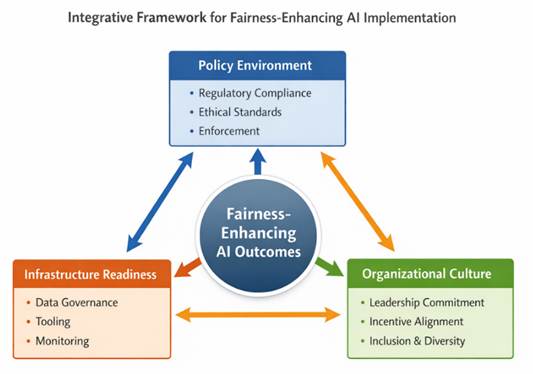
indicate that successful fairness-promoting AI needs a cohesive sociotechnical
ecosystem that includes infrastructure, enforceable policy, and enabling
organizational culture, instead of using technical solutions.
|
Figure 1 |
|
Figure 1 Integrative Sociotechnical Framework for
Fairness-Enhancing AI Implementation |
Methodology
This research used
systematic literature review (SLR) to bring together empirical and conceptual
research on fairness-enhancing AI, and this involved infrastructure, governance
frameworks, and organizational culture. The PRISMA guidelines were used to conduct
the review to provide clear selection, screening and reporting procedures. The
latest articles that were published until January 2026 were found in the
largest academic databases, such as Scopus, Web of Science, IEEE Xplore,
ScienceDirect, SpringerLink, Wiley, MDPI, arXiv, and Google Scholar.
Pre-established keywords were employed with Boolean operators, which included
fairness in AI, algorithmic bias mitigation, AI governance, and organizational
culture. Following the elimination of duplicates, studies were filtered using
the title, abstract, and full text, according to the inclusion criteria that
focused on the implementation contexts. Peer-reviewed publications that were in
English were only included. The extraction and analysis of the data were done using
narrative synthesis and grouping the results in categories of infrastructure
readiness, policy alignment, and organizational culture to find the key
enablers, barriers, and gaps in research.
Inclusion and Exclusion Criteria
Articles were
screened according to their consideration of at least one of the two main
themes of the present review (i) the technical and infrastructural
underpinnings of implementing fairness-enhancing AI technologies, including
data governance systems, fairness measures and metrics, bias mitigation
algorithms, life cycle monitoring tools, and AI auditing systems, and (ii) the
governance and organizational aspects that affect the way fairness is
implemented, including AI policy models, regulatory frameworks, compliance
systems, institutional accountability models, leadership commitment, and
organizational culture processes. Both empirical (quantitative, qualitative or
mixed-methods) and conceptual or methodological research were included in terms
of providing the opportunity to conduct the synthesis of the theoretical
advances and the practices of the real-world implementation comprehensively.
Included in the
studies were those lacking transparency of methods, not reviewed by peers (with
the exception of influential technical reports by reputable institutions), and
those dealing only with abstract notions of fairness without mention of implementation
settings. English-language publications were taken into consideration only to
make sure that there are similarities in conceptual interpretation and the
rigor of analysis.
Selection Process
To enhance
transparency and reproducibility, a structured screening procedure that relied
on PRISMA (Preferred Reporting Items to Systematic Reviews and Meta-Analyses)
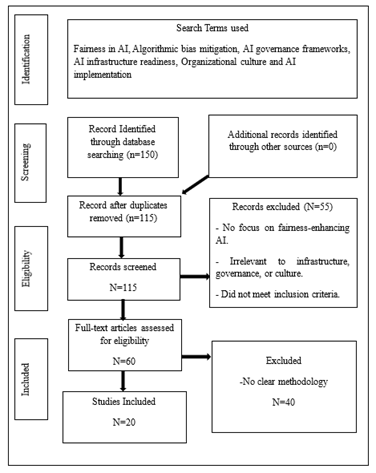
framework was used. First, 150 records have been found in the identified
academic databases, such as Scopus, Web of Science, IEEE Xplore, ScienceDirect,
SpringerLink, Wiley Online Library, MDPI, arXiv, and Google Scholar. Upon
eliminating the redundant records, 115 records were left to be screened in
terms of titles and abstracts. At this step, 55 articles were filtered out due
to either ignoring fairness-enhancing AI implementation or being irrelevant to
the topic of infrastructure, governance, or organizational culture.
Among them, 40
were excluded because they lacked a sufficient methodological description, had
a too technical scope that was not connected with sociotechnical and were too
limited in their ability to contribute to the implementation aspect of
fairness. Finally, it was possible to include 20 studies in the final
synthesis. The analyses of these studies were systematically done and
thematically classified based on the infrastructure preparedness,
policy-regulatory fit, and organizational culture and change management. The
conclusion review allowed discovering implementation patterns, barriers,
enabling mechanisms, and unresolved gaps in research on the implementation of
fairness-promoting AI technologies in a variety of institutional settings.
|
Figure 2 |
|
Figure 2 PRISMA Flow Diagram of the Study |
Results
The systematic
review has been able to identify 20 eligible studies that overall evidence the
idea that the introduction of fairness-enhancing AI technologies is being
influenced by three closely related themes, which are infrastructure
preparedness, policy and regulatory alignment, and organizational culture and
governance dynamics. These themes also represent the sociotechnical character
of the fairness implementation discovered during the course of the review.
Infrastructure Readiness and Technical Capacity
The initial theme
that prevails relates to how infrastructure forms the basis of
operationalization of fairness. It has been explicitly pointed out in the
analyzed articles that risk metrics and bias reduction methodologies require
well-developed systems of data governance, lifecycle management systems,
documentation rules, and audit systems Pagano
et al. (2022). It is within organizations whose data flow
is not organized, reporting is inconsistent, and where they lack constant
scrutiny mechanisms that do not abide with fairness interventions in long-term
of development Agarwal
et al. (2022), Framework
Convention on Artificial Intelligence. (2026). Based on several studies, equity testing is
normally conducted in the form of an experimental one-off technical test rather
than a built-in process of monitoring Mitchell
et al. (2019). This means that the results suggest that
the concept of infrastructure is the technical infrastructure that assists in
converting the abstract principles of fairness into practical forms of inquiry
that can be measured and audited
Policy and Regulatory Alignment
The second theme
correlates with the regulatory assistance system and the system of governance.
Although ethical codes and AIs principles of non-discrimination, transparency,
and accountability tend to be accepted Mittelstadt
et al. (2016), Floridi
and Cowls (2019), the review indicates areas of
inconsistencies in their implementation. Several policy regimes are not binding
as far as adhering and are not fully congruent with internal organizational
processes Pagano
et al. (2022). This kind of policy-practice disparity
negatively affects accountability as it does unfair in the institutions Kroll et
al. (2017). Based on the studies, AI technologies which encourage fairness have
more likelihood of being systematically introduced through the assistance of
transparent standards of rule, enforceable reporting frameworks, and
institutional oversight systems Murire
(2024).
Organizational Culture and Institutional Practices
The culture of the
organization is the third theme discovered to show the role of the culture of
the organization in the mediation of the infrastructure and policy. To make a
step towards the leadership commitment, the interdisciplinary work, the consciousness
of the ethicality and the regular incentives are a must in making fairness
central or marginal Murire
(2024). The performance-driven organizational
cultures that are mainly concerned with efficiency can consider fairness as a
peripheral consideration except when made strategic Rakova
et al. (2021). Common barriers leading to cultural
resistance, poor clarity of ownership of fairness responsibilities, and
insufficient expertise within an organization are also identified in the review Madaio
et al. (2020). The cultural dimensions are not studied
well as compared to the technical discussions giving a clear gap in the study
of internal institutional dynamics Selbst
et al. (2019).
Altogether, the
findings show that AI technologies aimed at enhancing fairness can be the most
effective when the infrastructural capacity, regulatory correspondence, and a
supportive organizational culture are held together in an integrated system of
the sociotechnical ecosystem.
Discussion
This review
findings provide an affirmation that fairness-promoting AI technologies cannot
be successfully introduced with the help of technical solutions only. Instead,
they flourish on a balanced integration of infrastructure, policy framework and
culture of the organization. The relative lack of qualified studies will also
reveal a research gap; when the measures of algorithmic fairness are widely
studied, less literature has tried to show how these tools are being
operationalized and situate it within the institution and operationality
context Mittelstadt
et al. (2016). This fact also aligns with more advanced
arguments against AI ethics literature stating that the concept of fairness is
often limited to mathematical terms rather than applied and practiced Floridi
and Cowls (2019). The needed sociotechnical perspective incites an essential perspective
therefore that the fairness outcomes are not only specified by the algorithms,
but by the organizational mechanisms, to which they are substantially subjected
Barocas
et al. (2019).
The dominance of
the research done by use of technology would suggest that the theory and the
practice of fairness have never been at par. Mitigation plans of the bias and
the fairness are increasingly becoming sophisticated, however, only when they
are backed by viable data governance, lifecycle monitoring and standardized
documentation systems, they can be efficient Mitchell
et al. (2019). Devoid of such systems, checks on fairness
will result in isolated reviews contrary to continuous accountability systems.
The last studies on AI auditing mention that internal audit procedures, open
reporting systems, and surveillance are critical to the operation of the goal
of fairness Raji et al. (2020). These findings help to substantiate the
importance of infrastructure as the layer within which the fairness enhancing
technologies can be implemented and put into work on a sustainable basis.
Another factor
that is determining but unequal is the policy structures. Despite the fact that
international principles and domestic AI rely on the idea of non-discrimination
and transparency, their application to enforceable principles remains unbalanced
[15]. Regulatory uncertainty applies in organizations that lower the drive to
add fairness and rather concentrate on passive compliance, just the minimum
before the law Selbst
et al. (2019). To make the AI ethics a compelling practice
consideration, as governance scholars argue, the institutional enforcement
mechanisms should be installed, and accountability channels well defined, to
implement ethics in AI practice Kroll et
al. (2017).
Organizational
culture has been identified to mediate the policy intent and technical
implementation. There is high influence of leadership commitment,
interdisciplinary team-work and incentive alignment in the prioritizing of
fairness or second-fiddle [18]. Performance-oriented cultures that highly
respect efficient cultures may perceive fairness as an appendage with the
exception of being tactically guaranteed Madaio
et al. (2020), Selbst
et al. (2019). Overall, the discussion indicates the
notion that the use of AI technologies that increase fairness can be productive
in case they are supported by a rational sociotechnical ecosystem comprising
the ability of the infrastructure, enforceable rules, and moral organizational
activities.
Conclusion
The paper had
performed systematic literature review on the influence of the infrastructure,
policy framework, and organizational culture on the successful uptake of AI
technologies that enhance fairness using a systematic PRISMA-based literature
review. They indicate that the problem of artificial intelligence fairness is
not a computational but rather a sociotechnical one. Despite the high level of
technical features regarding the mitigation of bias and metrics of fairness
development, it should be mentioned that they may be considered only
practically effective in case of the strong data governance systems and the
lifecycle monitoring systems and auditing systems. It is also indicated in the
review that the policy frameworks even after becoming increasingly articulated
at the international and national levels still aim to lack clear
operationalization; therefore, there is a lack of connection between the
ethical values and the realization of them. It was also established that the
organizational culture is a critical mediating variable that helps determine
the internalization of priorities of fairness, resources mobilization and
sustenance in institutions. These things as the commitment of the leaders, the
cross-disciplinary teamwork as well as constant incentive systems serve a vital
role in making fairness a routine or a token age-old appearance. Overall, the
synthesis validates the fact that AI technologies that increase fairness can be
effective in the case when the infrastructure capacity, compatibility of the
regulations, and ethical principles of the organization collaborate with each
other. The emphasis on the limited integrative literature suggests that the
future of AI is a gap in research which ought to enable technical innovation to
accommodate institutional governance and cultural transformation in a way that
AI can be executed in a responsible and sustainable way.
ACKNOWLEDGMENTS
None.
REFERENCES
ACM Conference on Fairness, Accountability, and Transparency. (2026). In Wikipedia.
Agarwal, A., Agarwal, H., and Agarwal, N. (2022). Fairness Score and Process Standardization: Framework for Fairness Certification in Artificial Intelligence systems (arXiv:2201.06952). arXiv.
Barocas, S., Hardt, M., and Narayanan, A. (2019). Fairness and Machine Learning: Limitations and opportunities. https://fairmlbook.org
Floridi, L., and Cowls, J. (2019). A Unified Framework of Five Principles for AI in Society. Harvard Data Science Review, 1(1).
Framework Convention on Artificial Intelligence. (2026). In Wikipedia. https://en.wikipedia.org/wiki/Framework_Convention_on_Artificial_Intelligence
Kroll, J. A., Huey, J., Barocas, S., Felten, E. W., Reidenberg, J. R., Robinson, D. G., and Yu, H. (2017). Accountable algorithms. University of Pennsylvania Law Review, 165(3), 633–705. https://doi.org/10.2139/ssrn.2765268
Madaio, S., Stark, L., Wortman Vaughan, J., and Wallach, H. (2020). Co‑Designing Checklists to Understand Organizational Challenges and Opportunities Around Fairness in AI. In Proceedings of the ACM Conference on Fairness, Accountability, and Transparency (FAccT) (343–353). https://doi.org/10.1145/3351095.3372878
Mitchell, M., et al. (2019). Model Cards for Model Reporting. In Proceedings of the ACM Conference on Fairness, Accountability, and Transparency (FAT\) (220–229). https://doi.org/10.1145/3287560.3287596
Mittelstadt, B., Allo, P., Taddeo, M., Wachter, S., and Floridi, L. (2016). The Ethics of Algorithms: Mapping the Debate. Big Data & Society, 3(2). https://doi.org/10.1177/2053951716679679
Murire,
O. T. (2024).
Artificial Intelligence and its Role in Shaping Organizational Work Practices
and Culture. Business, 14(12).
OECD. (2019). OECD Principles on Artificial Intelligence.
Pagano, T. P., et al. (2022). Bias and Unfairness in Machine Learning Models: A Systematic Literature Review (arXiv:2202.08176). arXiv.
Papagiannidis, E. (2025). Responsible Artificial Intelligence Governance: A Review. Technological Forecasting and Social Change.
Raji, I. D., et al. (2020). Closing the AI Accountability Gap: Defining an End‑to‑End Framework for Internal Algorithmic Auditing. In Proceedings of the ACM Conference on Fairness, Accountability, and Transparency (FAccT) (33–44). https://doi.org/10.1145/3351095.3372873
Rakova, B., Yang, J., Cramer, H., and Chowdhury, R. (2021). Where Responsible AI Meets Reality: Practitioner Perspectives on Enablers for Shifting Organizational Practices. In Proceedings of the ACM CHI Conference on Human Factors in Computing Systems (1–23). https://doi.org/10.1145/3411764.3445518
Selbst, A. D., Boyd, D., Friedler, S. A., Venkatasubramanian, S., and Vertesi, J. (2019). Fairness and Abstraction in Sociotechnical Systems. In Proceedings of the ACM Conference on Fairness, Accountability, and Transparency (FAT\) (59–68). https://doi.org/10.1145/3287560.3287598
Toronto Declaration. (2026). In Wikipedia. https://en.wikipedia.org/wiki/Toronto_Declaration
Álvarez, J. M., et al. (2024). Policy Advice and Best Practices on Bias and Fairness in AI. Ethics and Information Technology, 26, Article 31. https://doi.org/10.1007/s10676-024-09746-w
|
|
 This work is licensed under a: Creative Commons Attribution 4.0 International License
© DigiSecForensics 2026. All Rights Reserved.


