|
|
|
|
Original Article
Voice over Internet Protocol (VoIP) Network Forensics and Security: A Comprehensive Synthesis of Digital Investigation Techniques, Traffic Analysis, and Emerging Challenges
|
Vaishnavi
Raut 1, Kapil Shukla
2* 1 B.Sc.–M.Sc. Integrated Course in Forensic Science with
Specialization in Cyber Forensics, the National Forensic Sciences University,
Gandhinagar,
India 2 Assistant
Professor, School of Forensic Science, National Forensic Sciences University,
Gandhinagar, Gujarat,
India 3 National Forensic Sciences University, India |
|
|
|
ABSTRACT |
||
|
Voice over Internet Protocol (VOIP) has changed the way people communicate all over the world because it provides people with flexible and inexpensive alternatives to the traditional telephony. But this change presents complicated security and forensic issues that require expert investigation techniques. This review sees a significant shift in the open-standard protocol analysis towards the application-specific study of encrypted proprietary platforms including Zoom, Discord and Microsoft Teams. Memory forensics is now capable of retrieving volatile evidence found in RAM and machine learning has improved the detection of encrypted traffic to more than 95 percent. There are still persistent problems with real-time evidence collection, cross-platform compatibility and compatibility against developing encryption standards. The upcoming studies aim at automation, privacy preserving methods of investigation, and quantum resistant security models that would address the new forensic requirements. Keywords: Memory Forensics, Digital Forensics,
Network Forensics, Traffic Analysis, Behavioral Detection, Mobile Application
Forensics, VOIP Security, Artifact Recovery |
||
INTRODUCTION
VOIP brings a
fundamental change in the communication system by substituting the traditional
circuit-switched networks with the versatile packet-switched one. The
consequent benefit has resulted in mass cost-saving, increased flexibility, and
easy integration with digital platforms, which have changed how organizations
and individuals plan and communicate Federal
Communications Commission (2019). This change also comes with novel
challenges in fields of digital forensic, cyber-crime and network analysis.
Although traditional telephony is based on specialized telco infrastructure,
VoIP is built on the open Internet Nets, which introduce additional
vulnerabilities and investigation issues that need special approaches Alo and Firday (2013). VoIP forensics and security are worth
knowing more than just academically. Since VoIP technologies can serve as a
significant means of ensuring critical infrastructure, commercial activities,
and personal associations, they are appealing to cyber thieves, fraudsters, and
criminals. VoIP communications are volatile, and coupled with robust encryption
algorithms and proprietary protocols that make them difficult to recover
evidence and to detect threats, this makes it harder on investigators and
defenders. The present review provides 25-year (2000-2025) coverage of the
topic and summarizes 41 peer-reviewed papers, covering the field in both a
systematic and a critical manner. It recognizes significant changes in
techniques and priorities with the most prominent being the transition of open
protocols to sophisticated means of proprietary, encryption-based applications
that demand alternative investigative and defensive strategies.
Evolution of VoIP Research
VoIP forensics and
security have developed in various distinguishable stages all of which were
classified under different technical challenges and approaches. Initial
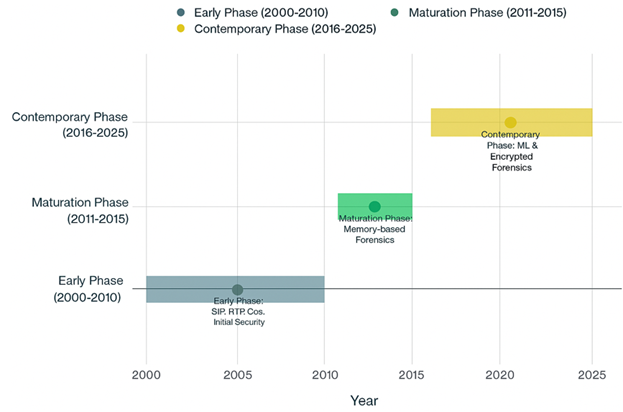
research between 2000-2010 concentrated around the major core protocols e.g.
SIP and RTP, basic quality of service parameters and early security issues in
fairly simple, non-encrypted settings.
The maturation
phase (2011-2015) witnessed the development of more sophisticated forensic
tools, i.e. memory-based analysis tools that reflect the nature of VoIP
communications being transient. The core methodology of this stage was then a
form of volatile memory analysis that revealed the feasibility of retrieving
rich communication artifacts through system RAM Irwin et
al. (2011).
The contemporary
phase (2016-2025) has been marked by the adoption of new machine learning
methods, the difficulty of decryption of encrypted communications, and the
transition to application-specific analysis as proprietary platforms have taken
over the communication market. This development is indicative of the larger
digitization of society and the growing complexity of technical means of
communication and threat actors. Figure 1 demonstrates the history of VoIP research
phases development.
|
Figure 1
|
|
Figure 1 Evolution Timeline of VOIP Research Phases |
Research Objectives and Contributions
The objective of
this review is to provide a consistent synthesis that would answer three major
questions: (1) methodical coverage of research developments in various fields,
(2) critical analysis of significant paradigm shifts and recurring challenges, and
(3) identification of future research opportunities that can inform both
academic and practical research.
The analysis
covers six main research areas that are distinguished by the systematized
sorting of 41 studies, offering a quantitative understanding of the trends in
research, but keeping a critical view of the methodological development and the
existing limitations. The integration of the broad coverage and advanced
synthesis makes this review a reference material to practitioners and a
conceptual base to future research directions.
VoIP Technology Overview
A good VoIP
forensic investigator should know how VoIP systems are constructed in order to
do effective VoIP forensics. VoIP networks do not operate in the same manner as
the traditional telephone networks. This advantage offers possibilities to
collect the evidence and also poses difficulties to security.
Basic VoIP Infrastructure and Protocols
VoIP systems are
constructed in two layers; one is the call setup (signaling)
and the other is the audio (media). As an illustration, the call is established
by SIP messages and the voice is transmitted in form of RTP packets.
The primary
standard that is currently used to configure and manage VoIP calls is Session
Initiation Protocol (SIP). SIP messages are important during a call setup as
they include information like caller ID, timestamps and session parameters. It
is quite helpful information to investigate: e.g., the From and To fields in a
SIP header makes you know instantly who is calling whom (Alo and Firday, 2013).
Real-time
Transport Protocol (RTP) transmits the actual voice data in a VoIP call. It
puts sequence numbers and timestamps on each audio packet so that the receiver
can play them in order. From a forensic standpoint, RTP packets also contain
clues like the type of audio codec in use or timestamps that show call
duration. However, because RTP is optimized for real-time delivery, packets can
get lost or arrive late on the network. Comparison of VoIP protocols and their
forensic significance is given in Table 1.
|
Table 1 |
|
Table 1 Comparison of VoIP
Protocols for Forensic Analysis |
||||
|
Protocol |
Type |
Encryption
Support |
Forensic
Accessibility |
Analysis
Complexity |
|
SIP |
Signaling |
Optional |
High |
Low |
|
RTP |
Media
Transport |
No
(plain) |
High |
Low |
|
H.323 |
Signaling/Media |
Optional |
Medium |
Medium |
|
SRTP |
Secure
Media |
Built-in |
Low |
High |
|
WebRTC |
Web-based |
Mandatory |
Low |
Very High |
VoIP employs
several audio encoders that compress voice information. For example, the G.711
codec provides excellent quality of audio at the cost of additional bandwidth,
whereas the G.729 uses more severe compression to save on bandwidth at the
price of a small amount of clarity. The data about the codec used provides the
investigators a clue regarding the quality of the call and the possible
artifacts in the data.
From Open Standards to Proprietary Applications
The history of the
voice over internet protocol (VoIP) has clearly shown the transition of not
only the open and standardized protocols but also the closed-source and
proprietary applications that have introduced the custom-made communication
channels. This shift of paradigm has made the investigators approach to new
models of methodology and has raised the fundamental issues of concern in the
field of forensic and security evaluation.
The modern
platforms, such as Zoom, Discord, or Microsoft Teams, use proprietary protocols
based on encrypted messages, which are regularly updated. As a result,
literature has become platform-specific, and the approach adapted to one
platform is not always transferable to other platforms, thus requiring
continuous adaptation and platform-specific reverse engineering Gupta et
al. (2024), Yu et al. (2025).
Measuring Quality and Performance in VoIP
Voice over
Internet Protocol (VoIP) services quality is measured through the combination
of the main metrics that directly influence user experience and forensic
analysis. These measures are critical towards the enhancement of the quality of
service and the creation of powerful analytical tools.
Jitter, as the
difference in time delay between arrival of packets, has a great impact on the
voice quality of VoIP communication. Unmanaged jitter might also lead to voice
distortion, delay or packet loss, and the jitter patterns chosen deliberately
can be used to mask malicious traffic and avoid detection mechanisms. Thus,
proper jitter control becomes crucial in ensuring the quality of service (QoS)
as well as the integrity and security of VoIP networks Khan and Suryawanshi (2019).
Packet loss i.e.
the ratio of packets sent and which do not reach the intended destination. High
loss rates mean that there is congestion in the network, which might be
security breach or system failure; in addition, loss pattern can be used in
explaining network topology, route behavior and other
anomalies related to forensics.
The Mean Opinion
Score (MOS) is a subjective measure of voice quality, which has a correlation
with objective network measures. The knowledge of the technical constraints of
the MOS scoring will enable the researchers to develop more effective
instruments of quality control and to approximate the effect of low performance
on the admissibility of forensic evidence.
Methods of Analysis
VoIP communication
requires special approaches unlike the conventional digital forensics and
network security. These strategies need to overcome the unstable voice
communication, scatter routes and increasing encryption systems.
Packet
capture-based network analysis is needed but struggles with rising encryption.
Deep packet inspection fails with encrypted data and relies on metadata and behavior approaches to infer communication without content
access.
Host-based
analysis is crucial with network approaches because VoIP programs leave traces
in memory, databases, and configuration files. Memory forensics on the VoIP
program enables examiners to restore artifacts in cases where network evidence
doesn't prevail or when encrypted.
Machine learning
and artificial intelligence identify patterns in encrypted traffic, profile behavior of communication, and identify anomalies. It is a
synthesis of rule- and probabilistic analysis to a deeper understanding but has
difficulties in model learning, verification and interpretation. Figure 2 illustrates the general workflow of forensic
investigation
|
Figure 2
|
|
Figure 2 VoIP Forensic Investigation Workflow |
Thematic Analysis and Research Classification
Analysis of 25
years of studies reveals apparent themes that are associated with technology
and security transformations. This section shows scopes of research and
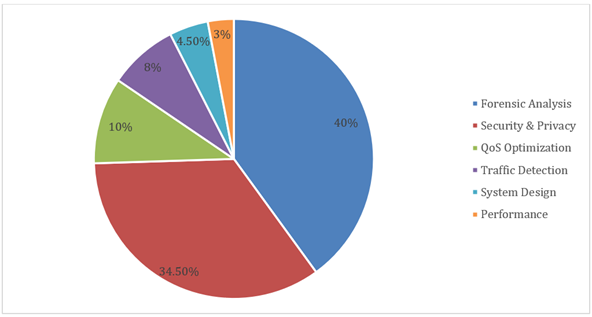
analyses methodology changes. Quantitative research indicates that forensic
examination and computer evidence recovery prevail with 40% of articles,
capturing the sensitivity of investigative capabilities in the development of
VoIP networks. The security and privacy research includes 34.5% and is
concerned with the unending threats in VoIP networks. Figure 3 shows the allocation of research areas on
the chosen studies.
|
Figure 3
|
|
Figure 3 Distribution of VoIP Research Domains
(2000-2025) |
Development and Evolution of Digital Forensic Methodologies
The field of
forensic analysis has evolved considerably, as simple packet analysis has
evolved into sophisticated multi-layer systems that can extract evidence by analyzing extremely sophisticated and encrypted data
infrastructure. This development was possible to a large extent due to the
increasing complexity of the infrastructure that is being utilized by the
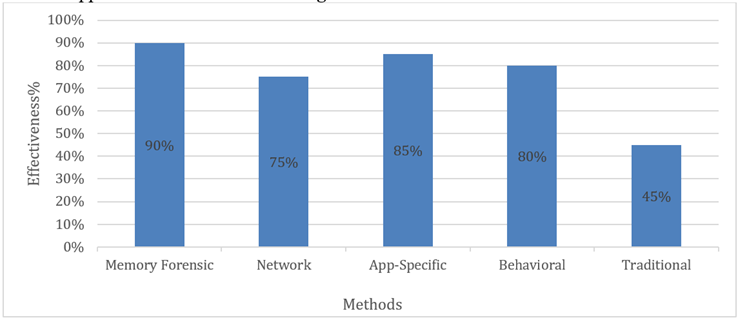
communication under consideration. The comparative effectiveness of different
forensic approaches is summarized in Figure 4.
|
Figure 4
|
|
Figure 4 Comparative Effectiveness of VOIP Forensic
Approaches |
Rise of Memory-Based Forensics
Memory forensics
is now the key method used to extract evidence from VoIP communications.
Researchers have shown that VoIP applications leave rich artifacts in volatile
RAM, even when no data is written to disk.
Irwin
and Slay (2011) demonstrated that VoIP packet artifacts and
SIP headers can be recovered from RAM using known hexadecimal patterns. They
focused on the Ethernet/IP/UDP/RTP stack and were able to reconstruct Skype and
X-Lite calls with high accuracy. Their work showed that memory analysis is a
powerful complement to traditional network forensics, especially when live
packet captures are unavailable. Javed et
al. (2022) also emphasize the role of volatile memory
and network forensics in the recent investigations, detailing the tools,
challenges, and developments to maintain the effectiveness of forensics in
reaction to emerging cyber threats.
Sophisticated
analysis of the memory has followed the shifts in applications. Irwin et
al. (2012) took memory forensic techniques a step
forward into audio reconstruction, restoring digital speech portions from RAM
after the call. This goes a long way beyond metadata recovery, and offers
access to the actual content of the communication in selective instances.
More recently,
forensic investigation of web and cloud-based communication has been revived. A
thorough forensic analysis of Google Meet by Iqbal et
al. (2022) allowed retrieving chat transcripts, meeting
links, information about participants, and metadata of sessions in both memory
dumps and browser artifacts in different operating systems. Based on
memory-based forensics, their study reveals that volatile memory and browser
data is abundant in user activity and meeting-related data and holds a useful
value in a cloud conferencing context. The customers of GoToMeeting were also
studied by Tiwari
(2025), which recovers the meeting metadata and the
AES keys and user interactions relying on the memory and browser artifacts.
Memory forensic
tools evolved as the methodologies upgraded. Al-Saadawi
and Varol (2017) contrasted tools such as Magnet IEF, Belkasoft, X-Ways, and Forensic Explorer, pointing out
their capabilities and limitations during VoIP artifacts identification. From
their results, they stressed the importance of the proper tool selection based
on various investigations.
Network Forensics and Traffic Reconstruction
Network-level
forensic is invaluable to successful VoIP investigations, most notably to analyze or observe distributed communications in real time.
It has also maintained technologically ahead of the VoIP protocol complexity,
as rising encryption.
Recent studies by Sarhan et al. (2023) introduced packet
inspection-based methods of analyzing VoIP instant
messaging calls. Their analysis found significant metadata such as source and
target IP addresses, times, and the protocols that are used on various
platforms such as Facebook Messenger, Skype, and WhatsApp. The study shows that
analyzing network-based forensic evidence can still
be useful to recover the communication metadata in the case of encrypted
content, so it can be used to support investigations where the content is
inaccessible using traditional methods.
Holistic forensic
systems significantly enhanced the analysis of networks. Mohemmed Sha et
al. (2016) presented a forensic VoIP analyzer based on SIP filtering, call identification, port
tracking, and RTP packet rescheduling to support voice reconstruction. Their
Java-based implementation successfully restored voice conversations from
traffic, providing investigators with powerful analysis tools for
communication.
Chetry
and Sharma (2024) researched on the issue of whether law
enforcement can determine VoIP calls by examining the IP address data in
network traces like IPDR and PCAP files. They focused on the interpretation of
metadata such as IP locations, time stamps, and patterns of connection to
identify the users of anonymous calls. It was also observed that encryption and
anonymization were also a challenge and it is necessary to thoroughly analyze network data, as it is still critical to find
evidence that will be used in court.
Network forensics
is limited by encryption and protocol obfuscation. End-to-end encryption is the
standard of many platforms, preventing the traditional way of packet inspection
and thus necessitating new approaches that focus on metadata inspection and traffic
pattern recognition instead of content inspection.
Application-Specific and Mobile Platform Forensics
New proprietary
messaging apps have necessitated specific forensic methods of each application
depending on the specific artifacts. This change implies that the analysts are
not doing protocol-level analysis anymore, but analyzing
data and behavior of each application.
Multi-platform
research provides some guidance on forensic technique applications for the
analysis of communication. Sgaras et al.
(2016) compared WhatsApp, Viber, Skype, and Tango
on Androids and iOS devices, outlined the taxonomies of artifacts, and
indicated the disparities in the accessibility of the data across platforms.
It was found that
Android provides stronger access to forensic analysis than iOS, varying between
applications on the same platform. Skype produced the greatest amount of
artifact generation, and WhatsApp had restricted recoverable data, highlighting
the importance of app-specific awareness during the course of an investigation.
Mobile forensic
analysis presents special difficulties in persistence of artifacts as well as
data recovery. It was indicated by Al-Saleh and Forihat (2013) that Skype artifacts are recovered on
Android devices even after the deletion of history or user logout, indicating
persistence of mobile VoIP applications.
More recent work
has expanded to cloud and collaboration platforms. For example, Gupta et
al. (2024) analyzed the
Discord application and were able to recover chat messages, user authentication
tokens, server details, and other metadata from memory.
Video conferencing
forensics has become extremely important as remote meetings become more common.
The recent studies have proven the ability to decrypt Zoom Team Chat databases
and disclose user interactions and activity despite the difficulty in encryption
Tresnadi (2025). Moreover, new forms of forensic analysis
using artificial intelligence and machine learning were used to scan through
social media, including video conferencing devices, and it highlights ethical,
legal, and scalability issues in decryption of encrypted communications Arshad
et al. (2025). In the meantime, the forensics of Tencent
Meeting memory has allowed retrieving valuable metadata and user interaction
artifacts within volatile memory Yu et al. (2025).
Security and Privacy: Detection to Behavioral Analysis
With the VoIP
systems, security researches have extended beyond discovering the gaps that can
be exploited by the protocols, to the application of advanced systems that
comprehend the malicious activities even with encrypted information. This
advancement emphasizes the fact that the methodology of attack is also becoming
complex and the defensive ability is being enhanced respectively.
Machine Learning in Traffic Detection and Classification
VoIP
identification has advanced to a higher level of behavioral
analysis that is able to determine the patterns of the communication even
though the traffic is encrypted. One such example is that,
earlier techniques employed header fields and a port number, however, Wu et al. (2008) suggested behavioral
approaches of identifying VoIP traffic through the application of Hidden Markov
Models on speech bursts and silence. With their approach, they were able to
achieve 95% and 97% accuracy in 4 and 11 seconds respectively, so they were not
just effective against encryption but also against alternate codes that had
already proven useful in challenging traditional techniques of detection.
A good alternative
to protocol-specific methods is statistical anomaly detection. Freire
et al. (2008) developed means of determining the VoIP call
hidden in the HTTP traffic according to the result of chi-square and
Kolmogorov-Smirnoff tests to achieve the detection rate of 90-100% with a
false-positive rate of 2-5%. Their findings demonstrate that it makes sense to
detect hidden VoIP traffic in other traffic channels.
Machine learning
has been the key factor that has changed the fundamentals of traffic
classification. Saqib et
al. (2017) proposed sophisticated statistical
techniques, which are grounded on signature detection, packet registration,
packet-size analysis, and transmission-rate analysis. It attained offline true
positive rates up to 93.6% and live analysis precision up to 95%, indicating
the capabilities of machine learning for the classification of encrypted
traffic.
The leading method
for VoIP traffic detection is Deep learning. Kapoor
et al. (2023) presented MAPLE and DATE models that convert
packet payloads into images and point clouds for CNN and MLP classification.
MAPLE attained over 99% accuracy in RTP stream detection, while DATE
demonstrated good results at various network conditions. These methods denote
the transition to representation learning that spots subtle patterns missed by
traditional methods.
The Advanced
steganography detection applies machine learning algorithms. Yang et al. (2019) developed fast neural network algorithms to
locate steganography in VoIP traffic according to the semantic mapping of the
quantized LSF codewords. It enhanced the speed to 20x with high accuracy of up
to 89%, indicating the possibility of real time security analysis.
Fraud Detection and Service Abuse Prevention
Detecting frauds
and usage of services are vital and research on VoIP security has turned out to
be essential. The shift from rule-based systems to advanced behavior
analysis shows the evolution of fraud methods and improvements in defense technologies.
In addition, it
enabled better identification of illegal traffic by utilizing new techniques. Anwar et
al. (2014) built algorithms for scanning packet
captures for extracting Call Detail Records (CDRs) for monitoring illegal VoIP
traffic by utilizing IP address blacklists. The method proved useful for
identification of illegal communication by removing false positives.
The recent
developments offer the rapid response to developing threats in real time fraud
detection technologies. The SCAMSTOP project Rebahi
et al. (2011), Rebahi
et al. (2013) further refined the area by generating the
Spam over IP Telephony (SPIT)-specific adaptive signatures and by enforcing the
anomaly-detection algorithms in the working service-provider systems, hence
proving the practicability of automated fraud-detection as it is conducted
nowadays.
Behavioral profiling is a sophisticated fraud-detection
model that is dynamically changing to the changing attack techniques. The
technologies that were analyzed by Rebahi
et al. (2011) include neural networks and behavioral analysis, where it is important to note that
threat intelligence should be shared on a mutually cooperative basis by
jurisdictions and service providers.
The performance of
fraud detection has been significantly enhanced by the use of sophisticated
machine-learning methods. The SPIT detection systems proposed by Azad et al. (2018) incorporate several processes like
collaborative filtering, which leads to greater accuracy rates and reduced
false-positive rates.
Understanding Privacy and Encrypted performance
The emergence of
privacy-sensitive technologies presents new obstacles to security analytical
research and encourage the creation of new analytical paradigms in the
encryption field; therefore, the field is extremely dynamic in terms of
research.
The analysis of
encrypted traffic no longer focused on the analysis of content, but rather the
analysis of metadata and behavioral features. Sarhan et al. (2023) created frameworks of the
forensic examination of encrypted traffic network showing that both timing
analysis and statistical profiling can be performed without decryption of the
content. Their approach was effective to predict events in the encrypted Telegram
and WhatsApp traffic.
Traffic analysis
is used to identify the language of encrypted communications. Wright
et al. (2007) demonstrated that language identification
(66%) and binary classification (86%) could be achieved by encrypting VoIP
traffic, even though the sizes of packets vary due to variable-bitrate
encoding. The current paper sheds light on the continued information leakage in
encrypted settings.
Secure
communication systems have been attacked by privacy-attack techniques. Zhu and Fu (2010) carried out traffic -analysis attacks on
encrypted Skype by using Hidden Markov Models to identify speaker related
features and link communication sessions. They have found that encryption
cannot be used alone to protect against sophisticated methods of
traffic-analysis. The development of
privacy-sensitive analytical processes aims at achieving the balance between
security and privacy.
Quality of Service and Performance Optimization
Quality of Service
(QoS) studies have developed primitive measures of performance, to more
advanced optimization models that include machine learning and adaptive
algorithms as a consequence of the increased complexity of networked settings
and the increased need of high-quality real-time communications.
Enhancing and Analyzing Network Performance
VoIP quality
literature has defined the determinants that are critical in any network
infrastructure. In their experimental studies, Olateju et al.
(2019) demonstrate that wireless Local Area
Networks (LANs) have poor performance compared to wired LANs in three metrics:
jitter, indicators of voice quality, and loss of packets.
The acquired data
have some information about the system performance with heavy implications on
the system design and forensic investigation. Particularly, wired networks
exhibit slight and predictable jitter behavior,
thereby providing a superior user experience and generating predictable traffic
behavior that can be utilized in reconstructing
forensic investigations and in investigating malware.
There has been an
enormous expansion in VoIP traffic mathematical modeling.
To define jitter and packet loss, Toral-Cruz
et al. (2011) suggested multifractal and Markov chain
models that give unambiguous dependencies between the parameters of the network
and the measures of service quality that enable working with proactive control
of performance and the detection of anomalies.
Heavy
signal-processing to enhance the quality of VoIP in harsh environments has been
adopted. Indicatively, Singh
(2024) used 4G and 5G networks to perform wavelet
transform on VoIP networks and, therefore, minimized latency and maximized
throughput using Daubechies wavelet algorithm to compress and optimize audio
transmission.
Adaptive Quality Management Systems
Dynamically
changing services to volatile network conditions and user requests with
adaptive QoS management systems using optimization and machine-learning
approaches represents a significant advancement over the traditional practice
of using static configuration.
VoIP-HDK2 model
proposed by Chakraborty
et al. (2020) had an overall mean opinion score higher
than 4.0 and thus minimized the call drops and packet losses in diverse network
conditions. This model makes use of the k-nearest neighbor,
hidden Markov modeling and k-means clustering to
control performance under changing conditions demonstrating the adaptive nature
of intelligent systems in the changing network conditions.
The wireless
environment optimization is used to solve the problem of mobility, bandwidth as
well as interference. Eriksson
et al. (2000) have come up with the ROCCO (Robust Checksum
-Based Header Compression) protocol of VoIP over wireless networks, with a 90%
capacity efficiency against a 50% capacity efficiency with uncompressed
headers. This paper highlights the importance of optimizing protocols on
resource-limited environments.
Modern studies
integrate artificial intelligence in the predictive quality management. In Chaudhari
et al. (2023), AI-based voice intelligent identification
of VoIP-based calling was proposed, which uses speech recognition and natural
language processing to improve the quality of calls and call routing in order
to improve the effectiveness of customer service.
Modern Methods for Traffic Detection and Classification
Network traffic
has been highly developed in terms of its detection and classification. The
study area transitioned to the complex behavioral
approach, rather than the simple protocol-based approach, which is effective
even when the traffic is encrypted or obfuscated. Behavioral
and statistical models form the basis to this advancement and identify repeated
patterns of communication and derive useful features where the contents of
packets are inaccessible. This results into highly accurate detection and at the
same time, lower rates of false positives.
Machine and deep
learning have changed the ability to classify traffic. The techniques enable
systems to analyze intricate patterns that are not
possible to the human eye and react to the real-time needs. Through neural
network models and transforming raw network data to form that can be easily
understood by a pattern recognition algorithm, are can effectively handle
encrypted VoIP traffic and have a high accuracy despite different high-speed
networks.
System Design and Implementation
The study is based
on the design of architectures that incorporate security, high-performance, and
forensic features at the design stages instead of at the post-design
implementation stage.
Integrated Security Architectures
The design of
security architecture is to protect against numerous threat vectors. A study by
Tuleun (2024), demonstrated the way an Asterisk-based VoIP
network could be rendered safe by adding VPN-encryption, safeguarded by
firewalls, and capable of intrusion detection, thereby mitigating common attack
vectors.
Blockchain provide
new solutions to safeguarding VoIP. Sreenivasulu and Ravikumar (2025), for example, proposed creating Fractal Net
keys authenticated by blockchain, and their solution provided improved
verification speed and security compared to current methods.
Intelligent System Integration
Inclusion of AI in
VoIP systems has created self-adjusting platforms that can enhance performance
and security in real time. These reflect a major step forward in the
development of the static configuration methods, since it enables constant
adjustment to the evolving conditions. Having cuckoo search optimization in
their work allowed Kumar
and Roy (2022) to optimize up to 98% throughput regarding
machine learning classifiers and enhance security because of the introduction
of intelligent threat detection and response schemes. To summarize the main
areas and representative studies of the research, Table 2 has been created.
|
Table 2 |
|
Table 2 Summary
of Key VOIP Forensics Research Areas, Studies, and Insights |
||
|
Category |
Key
Studies |
Insights |
|
Memory Forensics |
Irwin and Slay (2011), Irwin et al. (2012), Al-Saadawi and Varol (2017), Iqbal et al. (2022), Tiwari (2025), Yu et al. (2025) |
RAM and volatile
memory yield crucial call/session artifacts |
|
Traffic
Analysis |
Freire et al. (2008), Wu et al. (2008), Saqib et al. (2017), Kapoor et al. (2023) |
Traffic
features and ML models distinguish VoIP flows |
|
Encrypted VoIP
Forensics |
Zhu and Fu (2010), Wright et al. (2007), Sarhan et al. (2022) |
Even encrypted calls
leak metadata and language cues |
|
QoS
& Performance |
Toral-Cruz et al. (2011), Olateju et al. (2019), Singh (2024), Chaudhari et al. (2023), Eriksson et al. (2000) |
QoS
metrics affect forensic signatures of calls |
|
Security & AI
Integration |
Tuleun (2024), Kumar and Roy (2022), Sreenivasulu and Ravikumar
(2025) |
Blockchain & AI
enhance VoIP trust and resilience |
Critical Analysis: Paradigms, Challenges, and Persistent Limitations
As VoIP has
matured, protocol inspection methods have been generalized into AI-systems.
Among the changes that can be observed include implementation of encryption
that transforms what the expert is doing. Behavior
inference is then the most significant thing that is under investigation by the
investigators as they are examining general patterns of telecommunication and
not examining information stored within the message.
This shift means
the reconsideration of the equilibrium between the methods of analysis and
privacy issues. Ordinary VoIP encryption has made the old-fashioned forensic
techniques involving the use of header, packet content, obsolete Sarhan et al. (2023). Specialists have advanced
the methods of behavioral study and examine the
metadata trends, time relations, and statistical deviations to distinguish
communication properties without viewing direct information Saqib et
al. (2017), Kapoor
et al. (2023). The encryption that protects the privacy of
the user also complicates the detection of bad conduct and poses an ethical and
legal issue to balance the prerequisites of security and the rights to privacy.
Major VoIP security challenges and corresponding solutions are outlined in Table 3.
|
Table 3 |
|
Table 3 VOIP Security
Challenges and Solutions Assessment |
||||
|
Challenge |
Impact
Level |
Current
Solutions |
Maturity
Level |
Future
Outlook |
|
Encryption |
Very High |
Behavioral Analysis |
Developing |
Promising |
|
Real-time
Analysis |
High |
ML
Algorithms |
Developing |
Good |
|
Cross-platform
Compatibility |
High |
Universal Frameworks |
Early Stage |
Challenging |
|
Scalability |
Medium |
Cloud
Computing |
Mature |
Excellent |
|
Evidence Integrity |
High |
Chain of Custody |
Mature |
Stable |
From Protocols to Apps: A Shift in Analysis
Digital forensic
techniques have slowly developed as general protocol-based procedures to
application specific investigations. The shift can be explained by the variety
of communication platforms, in which the techniques that are effective with one
application, such as Skype or Discord, would not be effective with other
applications, such as Zoom. Consequently, the forensic practitioners face a
fragmented landscape of special equipment and understanding which makes the
process of evidence collection more complex and requires life-long learning.
These challenges are highlighted by Gupta et
al. (2024) and Yu et al. (2025), and Soni (2025) also points out that the ever-evolving and
diverse communication technologies require flexible forensic approaches to
overcome them.
The VoIP
technologies also experience fast evolutions, which worsen such issues. The
proprietary applications constantly modify their data processing methods and
data archival methods. Unlike standard protocols, these app-specific changes
demand researchers to continuously change their approaches, as published
methods can become outdated quickly. This case demonstrates the requirement for
forensic systems that are flexible enough to support effective investigation
despite regular updates.
Progress and Limitations in Analysis
Over the past
decade, manual tasks involving packet inspection, memory dump analysis Irwin
and Slay (2011), is now replaced with automated solutions
based on machine learning, and artificial neural networks. Existing methods use
algorithms for classifying features within encrypted traffic, automating
analysis of artifacts, and processing of large dataset beyond human
capabilities Kapoor
et al. (2023), Yang et al. (2019). Such approaches enhance analytical
capacity, thus allowing real-time recognition of patterns, probabilistic
decision, and reducing time, and proficiency required for VoIP investigation.
There are
high-level challenges involved in applying new methods to real-world forensics.
Most prominent among them is scalability: methods successful on small sets
struggle with the volume of real network traffic. Also, calculations that are
doable on experiments of a small laboratory scale are sometimes too slow to
support queries with time constraints. Such inconsistency between the
verification at the laboratory level and large-scale application in both method
verification and deployment discourage large-scale application of the modern
VoIP forensic techniques, which is why it is urgently required that studies be
conducted to identify limitations of the deployment setting of operational
forensics.
The Research-Practice Gap
Regardless of the
level of development in VoIP forensic science, a gap exists between laboratory
output and field application. The majority of studies are performed using
simulated data in laboratory, but testing the complexity of the real world is
not done. This raises questions about the effectiveness of these methods in
working environment with stricter constraints. Furthermore, non-uniform tools
and standards make integration difficult and slow down deployment. Without
common data formats and standardized methods, end-users struggle with abrupt
learning curves and quality assurance. Concluding this gap involves
verification against real datasets, improved integration of tools, and enhanced
standardization to deliver deployable VoIP forensic results.
Conclusion
VoIP forensics has
transformed radically to include basic protocol analysis to complex behavioral profiling and machine learning-based
investigations. Memory forensics has proven to be the most common methodology,
recovering useful artifacts out of volatile system memory where the traditional
network techniques fail. Artificial intelligence integration has transformed
the traffic-detection capacity of an investigator to detect VoIP communications
with an impressive precision in the presence of end-to-end encryption and
protocol obfuscation. Nevertheless, there are still serious problems that
require innovation. The disintegration of communication tools means that
investigators must be sufficiently skilled in various proprietary apps all with
their own forensic signatures. The computational limits of real-time analysis
and the volumes of network traffic still limit the capabilities to perform
real-time analysis, whereas the research-practice gap still prevents the
implementation of laboratory-tested methods in real-world settings. The fast
development of communication protocols gives a continuous arms race between
investigative technology and privacy protection technology. VoIP forensics
future is in creating automated cross-platform analysis systems capable of
keeping up with new technologies without violating privacy rights. The current
gaps in research should be filled with lightweight machine learning methods
which can be deployed in real-time, methods of forensic research that ensure
privacy, and quantum-resistant forensic models. The VoIP forensics future
depends on cooperation that combines development with values, allowing for
effective capabilities with respect for privacy.
ACKNOWLEDGMENTS
None.
REFERENCES
Al-Saadawi, H., and Varol, A. (2017). Voice Over IP Forensic Approaches: A Review. IEEE Xplore, 1–6. https://doi.org/10.1109/ISDFS.2017.7916507
Al-Saleh, M., and Forihat, Y. A. (2013). Skype Forensics in Android Devices. International Journal of Computer Applications, 78(7), 38–44. https://doi.org/10.5120/13504-1253
Alo, U. R., and Firday, N. H. (2013). Voice Over Internet Protocol (VoIP): Overview, Direction and Challenges. International Journal of Science and Technology, 2(3), 199–205.
Anwar, U., Shabbir, G., and Ali, M. A. (2014). Data Analysis and Summarization to Detect Illegal VOIP Traffic with Call Detail Records. International Journal of Computer Applications, 89(8), 1–7. https://doi.org/10.5120/15519-2724
Arshad, M., Ahmad, A., Onn, C. W., and Sam, E. A. (2025). Investigating Methods for Forensic Analysis of Social Media Data to Support Criminal Investigations. Frontiers in Computer Science, 7, Article 1566513. https://doi.org/10.3389/fcomp.2025.1566513
Azad, M. A., Morla, R., and Salah, K. (2018). Systems and Methods for SPIT Detection in VOIP: Survey and Future Directions. Computers and Security, 77, 1–20. https://doi.org/10.1016/j.cose.2018.03.005
Chakraborty, T., Ghosh, S., Barik, S., Kar, S., and Chatterjee, S. (2020). VoIP-HDK: A Novel Channel Allocation Technique for QOS-Aware VOIP Communication Over Heterogeneous Networks. Procedia Computer Science, 171, 62–71. https://doi.org/10.1016/j.procs.2020.04.007
Chaudhari, G., Korde, P., Patil, S., and Bhongal, R. (2023). VOIP-Based Intelligence Calling System. International Journal of Advanced Research in Science, Communication and Technology, 3(7), 1–6.
Chetry, A., and Sharma, U. (2024). Investigating VOIP Calls: Law Enforcement Perspective. INFOCOMP Journal of Computer Science, 23(2).
Eriksson, G. A. P., Olin, B., Svanbro, K., and Turina, D. (2000). The Challenges of Voice-Over-IP-Over-Wireless. Ericsson Review, 1, 20–31.
Federal Communications Commission. (2019). Voice Over Internet Protocol (VOIP).
Freire, E., Ziviani, A., and Salles, R. (2008). Detecting VOIP Calls Hidden in Web Traffic. IEEE Transactions on Network and Service Management, 5(4), 204–214. https://doi.org/10.1109/TNSM.2009.041102
Gupta, K., Lanka, P., and Varol, C. (2024). A Holistic Digital Forensic Analysis of Discord: Storage, Memory, and Network Perspectives. Journal of Forensic Sciences, 69(4), 1320–1333. https://doi.org/10.1111/1556-4029.15548
Iqbal, F., Khalid, Z., Marrington, A., Shah, B., and Hung, P. C. (2022). Forensic Investigation of Google Meet for Memory and Browser Artifacts. Forensic Science International: Digital Investigation, 43, 301448. https://doi.org/10.1016/j.fsidi.2022.301448
Irwin, D., Dadej, A., and Slay, J. (2012). Extraction of Electronic Evidence from VoIP: Identification and Analysis of Digital Speech. Journal of Digital Forensics, Security and Law, 7(1). https://doi.org/10.15394/jdfsl.2012.1128
Irwin, D., Slay, J., Dadej, A., and Shore, M. (2011). Extraction of Electronic Evidence from VOIP: Forensic Analysis of a Virtual Hard Disk vs RAM. Journal of Digital Forensics, Security and Law, 6(3). https://doi.org/10.15394/jdfsl.2011.1086
Irwin, D., and Slay, J. (2011). Extracting Evidence Related to VOIP Calls. In IFIP Advances in Information and Communication Technology (221–228). https://doi.org/10.1007/978-3-642-24212-0_17
Javed, A. R., Ahmed, W., Alazab, M., Jalil, Z., Kifayat, K., and Gadekallu, T. R. (2022). A Comprehensive Survey on Computer Forensics: State of the Art, Tools, Techniques, Challenges, and Future Directions. IEEE Access, 10, 11065–11089. https://doi.org/10.1109/ACCESS.2022.3142508
Kapoor, M., Napolitano, M., Quance, J., Moyer, T., and Krishnan, S. (2023). Detecting VOIP Data Streams: Approaches Using Hidden Representation Learning. Proceedings of the AAAI Conference on Artificial Intelligence, 37(13), 15519–15527. https://doi.org/10.1609/aaai.v37i13.26840
Khan, A., and Suryawanshi, R. (2019). Performance analysis of VOIP Codecs Under Variable Jitter and Delay Conditions. International Journal of Computer Applications, 178(43), 1–6. https://doi.org/10.5120/ijca2019918704
Kumar, V., and Roy, O. P. (2022). Enhanced Network Security for Improved Trustworthiness of VOIP Applications Via Cuckoo Search and Machine Learning. Indian Journal of Science and Technology, 15(15), 677–688. https://doi.org/10.17485/ijst/v15i15.1379
Mohemmed Sha, M., Manesh, T., and Abd El-atty, S. M. (2016). VOIP Forensic Analyzer. International Journal of Advanced Computer Science and Applications, 7(1). https://doi.org/10.14569/IJACSA.2016.070116
Olateju, A. I., Adenekan, O. A., and Abatan, T. T. (2019). Performance Evaluation of Voice Over Internet Protocol (VoIP) on Wired and Wireless Networks. Journal of Digital Innovations and Contemporary Research in Science, Engineering and Technology, 7(2), 87–100. https://doi.org/10.22624/AIMS/DIGITAL/V7N4P9
Rebahi, Y., Nassar, M., Magedanz, T., and Festor, O. (2011). A Survey on Fraud and Service Misuse in Voice Over IP (VOIP) Networks. Information Security Technical Report, 16(1), 12–19. https://doi.org/10.1016/j.istr.2010.10.012
Rebahi, Y., Ruppelt, R., Nassar, M., and Festor, O. (2013). SCAMSTOP: A Platform for Mitigating Fraud in VOIP Environments. In Proceedings of the International Conference on Network and Service Management. https://doi.org/10.4018/978-1-4666-1888-6.ch012
Saqib, N. A., Shakeel, Y., Khan, M. A., Mahmood, H., and Zia, M. (2017). An Effective Empirical Approach to VOIP Traffic Classification. Turkish Journal of Electrical Engineering and Computer Sciences, 25, 888–900. https://doi.org/10.3906/elk-1501-126
Sarhan, S. A. E., Youness, H. A., Bahaa-Eldin, A. M., and Taha, A. E. (2024). VoIP Network Forensics of Instant Messaging Calls. IEEE Access, 12, 9012–9024. https://doi.org/10.1109/ACCESS.2024.3352897
Sarhan, S. A. E., Youness, H. A., and Bahaa-Eldin, A. M. (2022). A Framework for Digital Forensics of Encrypted Real-Time Network Traffic, Instant Messaging, and VOIP Application Case Study. Ain Shams Engineering Journal, 14(9), 102069. https://doi.org/10.1016/j.asej.2022.102069
Sgaras, C., Kechadi, M., and Le-Khac, N. (2016). Forensics Acquisition and Analysis of Instant Messaging and VOIP applications. arXiv. https://doi.org/10.48550/arxiv.1612.00204
Singh, S. (2024). Performance Improvement for VOIP-Based Systems. Wireless Personal Communications, 139(1), 145–166. https://doi.org/10.1007/s11277-024-11594-2
Soni, N. (2025). Digital forensics: Confronting Modern Cybercrimes, Technological Advancements, and Future Challenges. Forensic Legal and Investigative Sciences, 11(1). https://doi.org/10.24966/flis-733x/100105
Sreenivasulu, V., and Ravikumar, C. (2025). Fractal Net-Based Key Generation for Authentication in Voice Over IP Using Blockchain. Ain Shams Engineering Journal, 16(3), 103286. https://doi.org/10.1016/j.asej.2025.103286
Tiwari, N. S. K. (2025). Forensic Analysis of Browser-Based Go To Meeting Clients: Uncovering Memory and Browser Artefacts. Journal of Information Systems Engineering and Management, 10(20s), 483–495. https://doi.org/10.52783/jisem.v10i20s.3172
Toral-Cruz, H., Pathan, A. K., and Pacheco, J. C. R. (2011). Accurate Modeling of VOIP Traffic QoS Parameters in Current and Future Networks with Multifractal and Markov Models. Mathematical and Computer Modelling, 57(11–12), 2832–2845. https://doi.org/10.1016/j.mcm.2011.12.007
Tresnadi, A. (2025, March 17). Decrypting Zoom Team Chat: Forensic Analysis of Encrypted Chat Databases. InfoSec Write-ups. April 14, 2025.
Tuleun, N. W. (2024). Design of an Asterisk-Based VOIP System and the Implementation of Security Solution Across the VOIP Network. World Journal of Advanced Research and Reviews, 23(1), 875–906. https://doi.org/10.30574/wjarr.2024.23.1.2048
Wright, C. V., Ballard, L., Monrose, F., and Masson, G. M. (2007). Language Identification of Encrypted VOIP Traffic: Alejandra Y Roberto or Alice and Bob? In Proceedings of the USENIX Security Symposium.
Wu, C., Chen, K., Chang, Y., and Lei, C. (2008). Detecting VOIP Traffic Based on Human Conversation Patterns. In Lecture Notes in Computer Science (280–295). https://doi.org/10.1007/978-3-540-89054-6_14
Yang, H., Yang, Z., Bao, Y., Liu, S., and Huang, Y. (2019). Fast Steganalysis Method for VoIP Streams. IEEE Signal Processing Letters, 27, 286–290. https://doi.org/10.1109/LSP.2019.2961610
Yu, S., Li, B., Zhu, L., Zhang, H., Yang, S., Li, Z., and Feng, W. (2025). Tencent Meeting Forensics Based on Memory Reverse Analysis. PeerJ Computer Science, 11, e2963. https://doi.org/10.7717/peerj-cs.2963
Zhu, Y., and Fu, H. (2010). Traffic Analysis Attacks on Skype VOIP Calls. Computer Communications, 34(10), 1202–1212. https://doi.org/10.1016/j.comcom.2010.12.007
|
|
 This work is licensed under a: Creative Commons Attribution 4.0 International License
© DigiSecForensics 2026. All Rights Reserved.