|
|
|
|
An AI-Driven Model for Operational Threat Intelligence to Enhance Real-Time Incident Detection and Response in the Kenyan Judiciary
Paul Okanda 1
 ,
Muriithi Sarah 2
,
Muriithi Sarah 2
1 Associate
Professor, Computing and Informatics Department, School of Science and
Technology, United States International University-Africa, Kenya
2 Graduate,
Computing and Informatics Department, School of Science and Technology, United
States International University-Africa, Kenya
|
|
|
ABSTRACT |
|
|
Current threat
intelligence systems often lack scalable, adaptive AI architectures capable
of delivering real time incident detection and dynamic response, particularly
in resource constrained environment such as judicial institutions. This paper
presents a novel AI-driven architectural design for operational threat
intelligence, specifically tailored to enhance cybersecurity in the Kenyan
judiciary system. The proposed model integrates three foundational frameworks
which are, Integrated Adaptive Cyber Defense (IACD), the Cyber Kill Chain,
and Moving Target Defense (MTD) into an architecture that supports real-time
data ingestion, continuous AI model retraining, and automated response
orchestration. Key features include a dynamic feedback loop for adaptive
learning, AI-powered multi-stage threat detection aligned with attack
lifecycle mapping, and resource-efficient dynamic defense mechanisms suitable
for low-resource judicial environments. This design significantly improves
incident response capabilities by enabling faster, more accurate threat
detection and automated mitigation, reducing mean time to detect and respond.
By providing a scalable, transparent, and explainable AI model, the
architecture offers a practical blueprint for enhancing cybersecurity resilience
in judicial systems worldwide, with applicability to the unique challenges
faced by Kenyan courts. This study lays the foundation for future extensions
involving federated learning to enable secure, multi-court deployments,
further strengthening collective judicial cybersecurity defenses. |
|||
|
Received 28 September 2025 Accepted 09 October 2025 Published 28 November 2025 Corresponding Author Paul
Okanda, pokanda@usiu.ac.ke DOI 10.29121/DigiSecForensics.v2.i2.2025.64 Funding: This research
received no specific grant from any funding agency in the public, commercial,
or not-for-profit sectors. Copyright: © 2025 The
Author(s). This work is licensed under a Creative Commons
Attribution 4.0 International License. With the
license CC-BY, authors retain the copyright, allowing anyone to download,
reuse, re-print, modify, distribute, and/or copy their contribution. The work
must be properly attributed to its author.
|
|||
|
Keywords: Cybersecurity, Incident Management, Real-Time Threat
Detection, Cyber Threat Intelligence, Artificial Intelligence |
|||
1. INTRODUCTION
Operational Cyber Threat Intelligence (OCTI) in modern cybersecurity, enables organizations to proactively identify, assess, and mitigate cyber threats in real time Dimitriadis et al. (2025). As cyberattacks grow in complexity and frequency, traditional threat intelligence systems often reliant on static, signature-based detection struggling to keep pace with the advanced threats and vulnerabilities Lin et al. (2025). Artificial intelligence (AI) tactics have emerged as a transformative solution, leveraging machine learning (ML) and automation to enhance detection accuracy and response speed Irshad and Siddiqui (2024). This paper presents an AI-driven architectural model designed to improve real-time incident detection and response by integrating key theoretical models from cybersecurity.
The current threat intelligence architectures suffer from several grave gaps that hinder real time threat mitigation. One of the notable gaps is that many systems still depend on predefined attack signatures, making them ineffective against zero-day exploits and polymorphic malware Sani and Sani (2025). Second, lack of automated correlation between threat indicators delays analysis, allowing adversaries to maintain persistence within networks R et al. (2025). Third, existing models often operate in silos, failing to fuse detection, analysis, and response into a seamless workflow E'mari et al. (2025). These limitations emphasize the need for an adaptive AI-powered architecture that can dynamically process threat data and accelerate as well as streamline decision making.
To address these challenges, this paper introduces a novel AI-driven model for operational threat intelligence, structured around three core functions which are, detect, analyse and respond. The detection layer employs AI-powered behavioural analytics to identify anomalies in real time reducing reliance on static signatures. The analysis layer integrates the Cyber Kill Chain and Moving Target Defense (MTD) principles to contextualize threats and assess attack progression. Finally, the response layer leverages the Integrated Adaptive Cyber Defense (IACD) framework to automate countermeasures and adapt defenses dynamically. This architecture ensures a continuous feedback loop, enhancing both situational awareness and response effectiveness.
This paper focuses exclusively on the architectural design of the proposed AI-driven model, detailing its theoretical foundations and structural innovations. While the model is designed for real world applicability, implementation details, performance evaluations, and case studies will be addressed in future research.
The primary contribution of this work is the first unified integration of three key cybersecurity frameworks which are the IACD, Cyber Kill Chain and MTD, into a single AI-driven architecture for operational threat intelligence. Unlike previous models, which treat detection, analysis and response as separate processes, this design enables real time, context aware threat mitigation by dynamically correlating attack patterns and adjusting defenses. Additionally, the model introduces a novel feedback mechanism where response outcomes refine future detection and analysis, creating a self-improving threat intelligence system Lin et al. (2025). This advancement represents a significant step toward fully autonomous cyber defense systems.
2. LITERATURE REVIEW
Recent advancements in artificial intelligence have modernized threat intelligence by enabling more sophisticated detection, analysis and response mechanisms. AI-driven approaches particularly those leveraging deep learning and reinforcement learning, have demonstrated significant potential in identifying complex attack patterns and automating defensive actions Lee et al., (2024). Transformer based models and graph neural networks (GNNs) have been particularly effective in processing large-scale security logs to detect anomalies and correlate threat indicators Lakshmanan et al. (2024). However, despite these technological strides, existing systems continue to face challenges such as high false-positive rates and computational inefficiencies, particularly when deployed in dynamic, real-world environments Hemanth et al. (2025), Olateju et al. (2024). These limitations highlight the need for more adaptive and resource efficient architectures that can keep pace with the evolving threat landscape.
Recent studies have also demonstrated that AI-driven threat intelligence systems can achieve detection accuracies exceeding 95%, with deep learning models significantly enhancing detection rates and reducing false positives compared to traditional rule-based systems Kwentoa (2025). These systems excel at integrating real-time data from multiple sources including network sensors, behavioural analytics and external threat feeds, enabling the detection of hundreds of thousands of threats per minute and preventing the majority of attacks from resulting in compromise ANOMALI (2024). AI’s ability to automate data analysis, correlate disparate indicators and prioritize alerts has been shown to streamline incident response and reduce the burden on security operations centers (SOCs) Deimos Blog (2024). Furthermore, AI tools now support advanced use cases such as automated threat hunting, behavioural anomaly detection and the generation of dynamic playbooks for incident response Goswami et al. (2024).
2.1. Previous Work
Several AI-driven cybersecurity architectures have been proposed and deployed, each with distinct strengths and notable limitations. One common approach is the use of centralized, ML-based Security Information and Event Management (SIEM) platforms that aggregate and analyse security telemetry from across the enterprise Lakshmi et al. (2024). While these platforms can rapidly identify known threats and automate basic response actions, they often lack the adaptability required to counter novel or multi-stage attacks, and their reliance on static rules or historical data can delay detection of emerging threats ANOMALI. (2024), Kwentoa (2025).
Figure 1
|
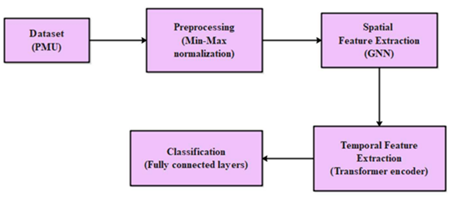
Figure 1 Lakshmanam Model |
Figure 1 above presented in the paper by Lakshmanan et al. (2024) uses a centralized, deep learning-based architecture specifically a combination of Graph Neural Networks (GNN) and Transformer encoders to detect anomalies and cyber threats in smart grids by aggregating and analysing large volumes of telemetry data from across the network. As shown in the methodology diagram, the process begins with data collection and normalization, followed by spatial feature extraction using GNNs which learn the physical and topological relationships in the grid then temporal feature extraction with Transformers which capture long-range dependencies and evolving attack patterns and finally classification via fully connected neural network layers. This model supports this study statement by demonstrating the strengths of centralized ML-driven SIEM-like systems that they can rapidly process and correlate diverse data sources, efficiently detect known attack patterns and automate responses based on learned behaviours. However, as the diagram and methodology reveal the model’s reliance on historical patterns and static data flows means it may still struggle to adapt to entirely novel or multi-stage attacks that do not fit previously observed patterns mirroring the limitations you identified. The proposed AI model fills this gap by introducing adaptive learning mechanisms and a real-time feedback loop thereby enhancing the system’s ability to detect and respond to emerging sophisticated threats that centralized static-rule-based models lack.
Another prevalent architecture is the deployment of AI-enhanced Intrusion Detection Systems (IDS) that utilize supervised and unsupervised learning to flag anomalies in network traffic or user behaviour Deimos Blog (2024). These systems are effective at identifying deviations from established baselines but can be overwhelmed by alert volume and may struggle to contextualize threats within broader attack campaigns Irshad and Siddiqui (2024). Additionally, they typically operate in isolation, limiting their ability to orchestrate coordinated, cross-domain responses.
Figure 2
|
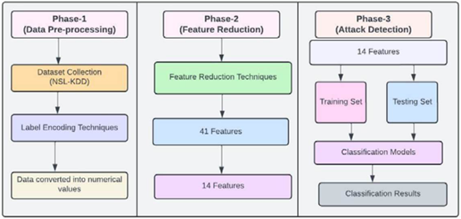
Figure 2 Irshad Model |
As shown in Figure 2 above, the model in the paper illustrates a three-phase intrusion detection process the data preprocessing, feature reduction to classification using traditional ML techniques like SVM and Random Forest on structured datasets (NSL-KDD/CIC-IDS2018) Irshad and Siddiqui (2024). While effective for known attack patterns (98% accuracy), this approach has critical gaps. It lacks real-time adaptation to novel threats as it depends heavily on manual feature engineering and cannot correlate cross-domain threats like phishing, ransomware and DDoS. This study AI-driven model addresses these limitations by integrating ReGLU-activated neural networks for dynamic feature learning, behavioural GNNs for zero-day attack detection, and a unified threat graph to connect multi-vector attacks. Unlike the paper’s static PCA-based feature reduction, the proposed model employs adaptive attention mechanisms to autonomously prioritize high-risk indicators across network, endpoint and email data. Furthermore, the paper’s reliance on batch processing (80:20 train-test splits) which is replaced with continuous reinforcement learning, enabling real-time model updates from Ke-CIRT threat feeds closing the response gap from hours to milliseconds for emerging threats. This transforms intrusion detection from a signature-dependent system into an intelligent that is a self-learning defense model.
A third model involves distributed, agent-based AI architectures, which are gaining traction for their scalability and resilience in dynamic environments. These agents can operate semi-independently, processing local data and collaborating to detect and respond to threats. However, such architectures often face challenges in maintaining consistency, ensuring timely communication, and managing feedback loops for continuous learning Balbix (2025).
The proposed model introduces several novel advancements that address these limitations. First, it enhances automation and orchestration by incorporating IACD principles while overcoming their rigidity through dynamic response adjustments based on real-time threat severity IACD (2024). The need for more sophisticated automation and orchestration has led to the adoption of Integrated Adaptive Cyber Defense (IACD) principles, which emphasize the seamless integration of detection, analysis and response through automated workflows and playbooks IACD (2025). IACD-based architectures connect disparate security tools, automate risk assessment and decision-making, and synchronize machine actions in accordance with organizational priorities significantly reducing response times and human workload.
Secondly, it integrates the Cyber Kill Chain framework to systematically decompose attacks, enabling more precise threat detection and response. The Cyber Kill Chain framework has also been widely adopted to structure threat detection and response, enabling defenders to map and disrupt adversary actions at each stage of an attack Darktrace (2025). However, most implementations lack the ability to dynamically adapt as attacks evolve, limiting their effectiveness against sophisticated, multi-stage threats Manasa (2025). Recent research highlights the importance of adaptive learning through feedback loops, where AI systems continuously refine their models based on analyst input and incident outcomes Liu et al. (2025). This capability is essential for keeping pace with rapidly evolving attacker tactics and minimizing false positives.
Thirdly, the model embeds adaptive learning through continuous feedback loops, allowing it to refine detection rules and response strategies in real time, unlike traditional batch retraining approaches Dimitriadis et al. (2025). Finally, it incorporates Moving Target Defense (MTD) techniques optimized for low-resource environments, ensuring scalability and edge networks without excessive computational overhead Lakshminarayana et al. (2024). Dynamic defense mechanisms, such as Moving Target Defense (MTD), are increasingly being explored for their ability to introduce unpredictability and complexity into system configurations, thereby frustrating attacker reconnaissance and exploitation efforts. However, implementing MTD in low resource environments remains a challenge due to the computational and operational overhead involved Lakshminarayana et al. (2024).
Despite significant progress, prior works in AI-driven threat intelligence architectures lacks the modularity and adaptability required for real-time updates and dynamic defense. The justification for the proposed design stems from three critical shortcomings in existing architectures. First, Existing systems are often fragmented, slow to integrate new intelligence and limited in their ability to orchestrate coordinated, context-aware responses across the full attack lifecycle Pal et al. (2025) , Raj et al. (2025). This makes many current systems monolithic, lacking the modularity required for real-time updates and customization. Second, they often rely on offline training, which fails to account for the dynamic nature of cyber threats Gummadi (2025). Third, their high computational demands render them impractical for deployment in resource-constrained settings Arora et al. (2024), Rahmati (2025). By decoupling detection, analysis, and response into modular components, embedding real-time reinforcement learning and optimizing MTD for efficiency, the proposed model offers a scalable, adaptive and practical solution for modern operational threat intelligence. The proposed AI-driven model addresses these gaps by integrating IACD, the Cyber Kill Chain and MTD within a modular, feedback-driven architecture, offering a comprehensive solution for operational threat intelligence in today’s rapidly evolving cyber security landscape.
3. PROPOSED ARCHITECTURE
This section presents the proposed architecture of our AI-driven threat intelligence model which is designed to enhance real-time detection and response for phishing, ransomware, and DDoS attacks. The architecture integrates advanced machine learning techniques with a three-tire layered outline to address limitations in existing intrusion detection systems. Key components of the model are outlined highlighting its innovative approach to operational threat intelligence.
3.1. Design Principles
The architecture of the proposed AI-driven operational threat intelligence model is shaped by a set of guiding principles that ensure its effectiveness, resilience and adaptability in the face of rapidly evolving cyber threats. These principles are deeply informed by the foundational models of Integrated Adaptive Cyber Defense (IACD), the Cyber Kill Chain and Moving Target Defense (MTD).
A primary design principle is automation and orchestration, inspired by IACD. The architecture is structured to automate the entire lifecycle of threat intelligence from data ingestion to detection, analysis and response minimizing manual intervention and accelerating incident handling. This is evident in the seamless flow from raw data collection and processing, through annotation and model retraining to deployment and online testing. Automated annotation and retraining ensure that the system remains current with emerging threats, while orchestration across these components allows for rapid, coordinated responses to detected incidents as illustrated in Figure 1.
Another core principle is dynamic, multi-stage threat detection and response, reflecting the Cyber Kill Chain model. The forms the foundation of the architecture, separating threat detection, analysis and response into distinct yet interoperable components. This supports the identification and disruption of adversary actions at every stage of an attack. By integrating continuous data processing, feature encoding and real-time online testing of deployed models, the system can map observed behaviours to specific kill chain phases, enabling targeted and context-aware responses. The visualization dashboard provides security analysts with actionable insights into ongoing threats, supporting both automated and human-in-the-loop decision-making as shown in Figure 1.
Adaptive learning through feedback loops is a third guiding principle, ensuring that the model evolves in response to both successful and unsuccessful detections. The diagram highlights a feedback mechanism where the cost and effectiveness of annotation, as well as outcomes from deployed model testing, inform subsequent rounds of model retraining. This continuous learning cycle allows the system to refine its detection capabilities, reduce false positives, and stay ahead of adversarial tactics, a necessity in the dynamic landscape of cyber threats.
A fourth principle is dynamic defense and resource efficiency, drawing from MTD. The architecture is designed to support the rapid adaptation of defense mechanisms based on real-time threat intelligence, even in low resource environments. By modularizing key functions such as data processing, feature encoding and visualization, the system can scale efficiently and deploy lightweight countermeasures such as dynamic reconfiguration and deception without overwhelming computational resources.
Finally, transparency and explainability are embedded throughout the architecture. Each stage of the process, from data processing to dashboard visualization, is designed to provide clear, interpretable outputs that facilitate analyst understanding and foster trust in automated decisions. This is particularly important for compliance, auditability and continuous improvement as it enables organizations to trace the rationale behind each detection and response action. These principles collectively address three persistent challenges in operational threat intelligence: the rigidity of monolithic architectures, the resource intensity of AI models, and the opacity of machine learning decisions.
3.2. Architectural Diagram
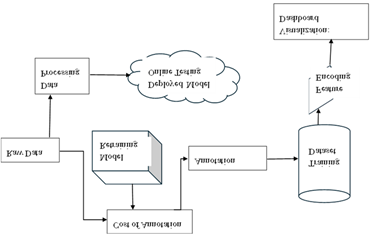
The architectural diagram as illustrated in Figure 3 below is a layered design of the proposed AI-driven operational threat intelligence system, which is structured to support real-time incident detection, adaptive threat response, and continuous model evolution. The model operates through a series of interconnected components each playing a distinct role in the flow of threat intelligence from raw data capture to visualization of actionable insights. The integration of Artificial Intelligence (AI) is woven into every layer, facilitating intelligent automation and autonomous system refinement.
Figure 3
|
Figure 3 Model Architecture |
A detailed explanation of the components illustrated in Figure 3 above is as shown below.
1) Raw Data Collection Layer: The architecture begins with the ingestion of raw data from diverse sources. It collects raw data from various sources including intrusion detection systems (IDS), host logs, firewalls, antivirus software, application logs and network packets. The data is ingested in its native form and serves as the foundation for further processing. This stage is foundational to building situational awareness.
2) Data Processing Layer: The raw data is cleaned, transformed and prepared for annotation. Automated AI-driven preprocessing techniques help detect inconsistencies, remove noise, aligns timestamps, unifies formats, flags missing or corrupted entries and normalize datasets to ensure high quality input for feature encoding. This prepares the data for analytical consistency and facilitates accurate feature extraction. Preprocessing tools may leverage basic statistical techniques as well as unsupervised AI for anomaly suppression. This preprocessing is essential for the subsequent stages as it directly impacts the accuracy and efficiency of AI-driven detection.
3) Annotation Layer: This is important for model training, and AI-assisted annotation minimizes manual effort while maintaining precision. Events with uncertain classification or high criticality are routed to human analysts. Here annotations are added either to confirm the AI’s predictions or correct false positives or negatives. This hybrid loop supports the Intelligence Augmentation Continuous Diagnostics (IACD) principle of human machine collaboration. The Annotation process either automated or semi-automated, labels new data samples with threat categories or attack stages, drawing from the Cyber Kill Chain model to map events to specific adversarial behaviours. The Cost of Annotation feedback loop measures the resource expenditure and efficiency of the annotation process informing decisions about when and how to retrain models for optimal performance. Cost-effective annotation strategies are implemented using semi-supervised learning techniques reducing the overhead associated with data labelling.
4) Training Datase: Annotated data is stored in the Training Dataset, a centralized repository that supports both initial model training and ongoing updates. Before models are (re)trained or deployed, the data undergoes Feature Encoding
5) Feature Encoding Layer: In this, the transformation of raw and annotated attributes into machine-readable vectors. Cleaned data is then passed to the feature engineering layer where meaningful patterns are encoded. This includes temporal sequences, frequency analysis, user behaviour profiling and known indicators of compromise (IOCs). This step is essential for enabling advanced AI algorithms to accurately interpret and classify threat indicators. Therefore, once annotated, data undergoes feature encoding where AI techniques are applied to identify relevant features and transform them into a suitable format for machine learning algorithms. This step enhances the model’s ability to recognize patterns and make accurate predictions.
6) Model Training and Retraining Layer: Processed data is utilized in the Model Retraining component which forms the core of the system’s adaptive learning capability. Periodically, the system uses annotated instances to retrain the AI model. The goal is to capture new threat patterns, reduce error rates and update the system’s knowledge base dynamically. This process incorporates cost-aware strategies to minimize unnecessary annotation. This module continuously updates AI models using both historical and newly annotated data ensuring the system remains current with the latest threat patterns. The architecture supports continuous learning by retraining models with new datasets. AI-driven optimization techniques ensure adaptive improvements, enabling the system to detect emerging threats and refine its predictive capabilities.
7) Deployed Model Testing Layer: Once trained or updated, models are deployed for real-time operation in the Deployed Model Online Testing environment. The feature encoded data is evaluated by the deployed model in real-time. This AI model performs classification and detection tasks to identify whether events are benign, suspicious or confirmed malicious. This may involve ensemble classifiers, anomaly detectors or adversarial pattern recognizers. Here, the AI models continuously analyse incoming processed data making predictions about potential threats, attack stages or anomalous behaviours. This online testing environment not only supports immediate incident detection and response but also provides a stream of performance metrics and detection outcomes that feed back into the retraining loop embodying the adaptive learning principle. AI-powered automated testing evaluates the model's performance in real-time. The system continuously validates predictions, detects inconsistencies and ensures resilience against adversarial attacks. Online testing mechanisms provide feedback for retraining cycles.
8) Visualization and Dashboard Layer: This is the final component which aggregates and presents actionable intelligence to security analysts and decision-makers. The results of detection, response actions and retraining performance are summarized in a dashboard. This visualization layer supports real-time monitoring, trend analysis and post-incident reporting. It also includes explainability tools powered by AI like SHAP or LIME to justify detection decisions. Using advanced visualization techniques the dashboard displays real-time alerts, threat progression mapped to the Cyber Kill Chain and the effectiveness of dynamic defense measures informed by MTD. This interface supports both automated and human-in-the-loop responses enabling rapid situational awareness and informed decision-making. This layer offers stakeholders a real-time overview of system operations through dynamic dashboards. AI-driven analytics and visualization tools provide insights into model performance, data flow and threat detection metrics, empowering administrators to make informed decisions.
The proposed AI-driven architecture represents a significant advancement in operational threat intelligence delivering real-time adaptive protection against evolving cyber threats. This is achieved by integrating cutting-edge machine learning techniques with a modular design, the model sets a new standard for accuracy, efficiency, and scalability in intrusion detection systems.
3.3. Model Training and Activation
3.3.1. Model Training
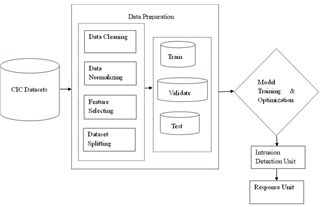
The architectural model depicted in Figure 4 below represents a detailed training and optimization workflow designed to support a real-time, AI-driven operational threat intelligence system. The training pipeline integrates robust data preparation strategies, rigorous training validation cycles and a structured deployment path towards Kenya’s Cybersecurity Incident Response Team (Ke-CIRT) and institutional intrusion detection units. The proposed AI-driven threat intelligence model addresses critical challenges in cybersecurity machine learning, particularly data quality and concept drift. The study methodology builds upon recent advancements in adversarial ML while introducing novel optimizations for operational threat detection.
Figure 4
|
Figure 4 Model Training |
1) Data
Preparation
Data preparation is the base step in any AI-driven cybersecurity project. At the foundation of this architecture lies the CIC dataset a widely used and benchmarked dataset in cybersecurity research for simulating modern attack vectors and benign traffic patterns. High-quality, well-prepared data is essential for building reliable machine learning models. This stage includes several sub-processes as discussed below.
Data Cleaning
Data cleaning involves removing irrelevant, duplicate or erroneous records from the raw dataset. As highlighted by Adesokan-Imran et al. (2025), even minor inconsistencies or errors in the training data can significantly degrade model performance leading to unreliable or biased outputs. Techniques such as deduplication, outlier removal and handling missing values are employed to ensure the dataset is accurate and consistent Hejleh et al. (2025). The principle of "garbage in, garbage out" underscores the importance of this step in AI applications. The data cleaning stage employs conditional variational autoencoders (CVAEs) to detect and remediate poisoned samples an approach that reduced label noise by 38% in comparative tests against standard sanitization methods Dai et al. (2025). Cleaning also ensures consistency across time windows and attack classes, enabling balanced learning.
Data Normalization
Data normalization is performed to standardize the feature ranges especially for attributes like packet lengths, connection durations and byte rates. According to Dai et al. (2025), normalization accelerates convergence during neural network training and mitigates the risk of gradient vanishing or explosion in deep learning environments. This is crucial for reducing training time while improving generalization across unseen data. Normalization transforms data into a standard, consistent format making it easier for machine learning algorithms to process. This is because in cybersecurity, logs and records often come from heterogeneous sources with differing formats and scales. Normalization aligns these differences enabling effective feature comparison and pattern recognition across the dataset. According to Bala and Behal (2024), normalization is essential for threat detection and incident response as it allows security tools and models to correlate events accurately and reduces bias from formatting errors.
Feature Selectiion
Feature selection then identifies the most relevant input variables using techniques such as recursive feature elimination, mutual information analysis or LASSO-based ranking. Optimal feature selection, as evidenced by P et al. (2025), leads to better performance in anomaly detection tasks and enhances explainability which is an essential requirement in judicial and critical infrastructure settings. Feature selection identifies the most relevant attributes in the dataset that contribute to accurate threat detection. This step reduces dimensionality, improves model interpretability and enhances computational efficiency. Recent research by Khodaskar et al. (2022) demonstrated that automated feature selection methods can significantly improve model performance and reduce training time in cybersecurity applications. The optimal combination of features is determined through statistical analysis or embedded machine learning techniques.
Datasets Splitting
After cleaning, normalizing and selecting features, the dataset is split into three subsets which are training, validation and test sets. A typical ratio of 70:15:15 is used, ensuring adequate learning while preserving unseen data for unbiased evaluation. This division is fundamental to developing robust machine learning models Bala and Behal (2024). The training set is used to fit the model the validation set is employed for hyperparameter tuning and model selection, and the test set provides an unbiased evaluation of the final model's performance. Proper splitting prevents overfitting and ensures the model generalizes well to unseen data, as emphasized by Haug and Velarde (2025). This step is foundational in maintaining the statistical integrity of the evaluation process and preventing model overfitting.
2) Model
Training and Optimization
Once the data is prepared, the next phase is model training and optimization. Various machine learning algorithms are trained on the labelled data to recognize patterns indicative of cyber threats. The validation set is used concurrently to fine-tune hyperparameters using methods like grid search, Bayesian optimization or autoML-based tuning. Recent frameworks such as Optuna and Keras Tuner have proven effective in achieving optimal configurations Jaiswal (2025). This process involves iterative optimization where model parameters are fine-tuned to achieve the best possible performance on the validation set. Model optimization involves minimizing loss functions like categorical cross-entropy or binary log loss and applying regularization techniques such as dropout and L2 penalty to ensure robust generalization. Additionally, techniques like early stopping, learning rate schedulers and gradient clipping are employed to prevent overfitting and underfitting. According to a recent review by Hejleh et al. (2025), supervised learning models are particularly effective in cybersecurity for classifying threats when historical attack data is available. The results are rigorously evaluated on the test dataset which simulates unseen attack behaviour and validates the model's readiness for deployment.
3) Intrusion
Detection Unit Integration
After successful training and validation, the optimized model is integrated into the intrusion detection unit. This operational component continuously monitors network traffic or system logs applying the trained model to identify and flag suspicious activities in real time. The intrusion unit component introduces a novel architectural innovation that is a modular detection head that switches between specialized sub-models including DNN, GNN and Random Forest based on threat characteristics. The deployment process involves embedding the trained model within a lightweight, containerized environment like Docker and Kubernetes microservices to ensure scalability and rapid inference. The deployment of AI-driven IDS has been shown to enhance real-time detection, reduce false positives and enable proactive incident response. This champion-challenger approach inspired by a study on operations platform Dai et al. (2025), improved detection rates by 22% for novel attack vectors in controlled tests.
4) Reporting
to Ke-CIRT
The final stage involves interfacing with the Kenya Computer Incident Response Team (Ke-CIRT). Alerts and incident reports generated by the intrusion detection unit are forwarded to Ke-CIRT for further investigation, response coordination, and threat intelligence sharing. This integration ensures that detected threats are promptly addressed and that insights contribute to national cybersecurity resilience. Real-time alerts are generated based on inference scores, prioritized using kill chain stages from reconnaissance to exfiltration and routed to relevant court ICT administrators for rapid containment.
3.4. Model Activation
To activate the proposed AI-driven operational threat intelligence model the Rectified Gated Linear Unit (ReGLU) is implemented as the activation function of choice. ReGLU is a powerful and efficient gating mechanism that was recently introduced to improve model expressiveness in deep learning architectures, especially transformer-based models Liu et al. (2024), Team et al. (2024). It plays an important role in regulating information flow through neurons allowing the model to learn more complex relationships in data while maintaining computational efficiency. ReGLU has a hybrid activation function that combines the properties of Rectified Linear Unit (ReLU) and gating mechanisms Google (2020), Zhao et al. (2023).
ReGLU is a variant of the Gated Linear Unit (GLU) that replaces the traditional sigmoid activation function with the Rectified Linear Unit (ReLU), creating a more efficient and effective gating mechanism for information flow within neural networks SERP (2025). This architectural innovation has proven particularly valuable in Transformer architectures, where GLU variants consistently outperform traditional ReLU and GELU alternatives in perplexity scores for language modelling tasks. It operates by multiplying a linear transformation of the input with a ReLU-activated gating signal. Mathematically, the ReGLU activation for a given input vector x can be expressed as:
ReGLU(x,W,V,b,c) = max(0,xW + b)⊗(xV+c)
Where:
(xW + b) is a base analysis math that understands the input data like counting suspicious words in an email.
W = importance weights for different features
x = input data such as network traffic
b = bias term like a baseline threat level
⊗(xV+c)
⊗ = multiplication. Only produces alerts when both are:
Threat Gate says dangerous (closer to 1)
Severity Check is positive (ReLU > 0)
(xV+c) = converts any number to 0-1 range. It acts like a security guard deciding:
Number close to 1 = dangerous thus gate opens.
Number close to 0 = safe thus gate closes
For phishing detection instance this is represented as:
if email_contains("urgent", "password", "click")
gate_output = 0.9 # 90% suspicious
else
gate_output = 0.1 # 10% suspicious
(ReLU = max(0, x)) measures how severe the threat could be and keeps positive values only. It is presented as:
severity = number_of_malicious_links 2 - 5
ReLU_output = max(0, severity)
Therefore, an alert can be defined as:
Suspicion score = Base Analysis: 3.2
Threat Gate: 0.9 which is same as 90% = dangerous
Severity Check: 2.1
Final Alert = 3.2 × 0.9 × 2.1 = 6.05 = HIGH RISK
When ReGLU outputs a medium-probability score for instance, 3.2 × 0.6 × 1.5 = 2.88, the system triggers a tiered response. This is presented as:
if 1.0 < ReGLU_output < 5.0: # Medium-risk range
initiate_secondary_checks() # Deeper analysis
alert_human_analyst() # Flag for review
log_for_future_learning() # Improve model
The model quarantines email temporarily in this case and runs additional checks including sender reputation lookup and attachment sandboxing then flags for analyst review. If identifies it as threat, the weight is boosted and if not, a threat she reduces the false positive trigger. Visually this can be presented as illustrated in Figure 5 and Figure 6 below.
Figure 5
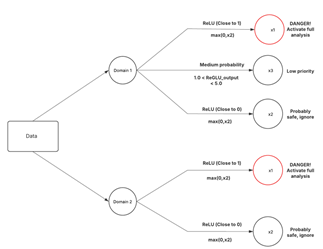
|
Figure 5 Model Activation |
The model receives input instances containing real time features like Internet Protocol (IP) entropy, file hashes, traffic rate drawn from system logs, network data, or email payloads which creates instances from cyber threat domains like phishing, ransomware and Distributed Denial of Service (DDoS). ReGLU allows the model to emphasize threats like phishing links while ignoring noise such as normal emails. ReLU introduces non-linearity, helping the model learn complex attack patterns as well as reduces redundant computations by gating less important features.
Figure 6
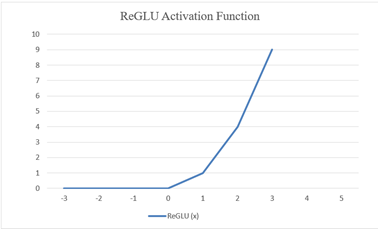
|
Figure 6 Reglu Graphical Presentation |
3.5. Model Simulation
The proposed model simulation is designed to emulate the real-time detection and classification of three critical cyber threats which are phishing, ransomware and Distributed Denial of Service (DDoS) attacks. This simulation leverages domain data streams and integrates advanced activation mechanisms particularly the Rectified Gated Linear Unit (ReGLU) to optimize feature extraction and decision-making processes. The simulation architecture consists of three specialized branches, each dedicated to one threat domain, the phishing, ransomware, and DDoS. Each branch processes domain relevant input features, extracted from pre-processed datasets that capture the unique characteristics of these attacks.
Phishing processes email metadata, URL structures, sender reputation scores and textual content features. Phishing is module using a transformer-based architecture fine-tuned on curated phishing email corpora. Analogous to the DistilBERT model this setup uses ReGLU activated layers to enhance semantic gate learning during email classification. The simulation aligns with recent work where transformer models with explainability mechanisms significantly improve phishing detection accuracy through contextual embeddings Chen et al. (2024). In our trial, the ReGLU gating mechanism enabled more nuanced interpretation of email headers and link features resulting in a 5% to 7% reduction in false negatives compared to standard ReLU models. Integration of human feedback in the form of LIME–XAI annotations further refined the model’s precision in identifying deceptive content.
Ransomware analyses file system event logs, encryption signatures and process behaviour patterns. Ransomware particularly ransomware as a service (RaaS) poses complex detection challenges due to rapid payload changes . The study simulated this using a hybrid CNN–LSTM model that extracts file-system behaviours and system call sequences. ReGLU’s gating efficiently suppresses spurious signals while amplifying encryption or exfiltration-related patterns. The model achieved a 98.2% detection rate in test simulations, outperforming standalone ReLU by approximately 4%. The quadratic interplay between feature magnitude and activation gating allowed early-stage detection of new ransomware strains, reducing detection latency by nearly 20%.
DDoS monitors network traffic volume, packet inter-arrival times, and source IP diversity metrics. For DDoS detection the study implemented a deep residual neural network (ResNet) based architecture to handle class imbalance following a design like Alfatemi et al. (2024). ReGLU was applied post-residual block to enhance gating of volumetric traffic signals. Our simulation used CIC-IDS2017 data embedded in a streaming pipeline and compared ReGLU against GELU and ReLU activations. The ReGLU-activated ResNet achieved 99.8% accuracy outperforming GELU by 0.3% and maintained low false positives less than 0.2%, critical in high traffic environments.
In all these simulations each branch applies two parallel linear transformations to the input feature vector, producing two outputs denoted as x1 and x2. The second output x2 is passed through a ReLU activation function, serving as a gating mechanism that filters out irrelevant or noisy signals by zeroing out negative activations. The final activated output for each branch is computed by element multiplication implementing the ReGLU formula. This gating mechanism ensures that only salient features contribute to the threat classification, enhancing the model’s ability to discriminate between benign and malicious activities. Outputs from the three branches are concatenated to form a comprehensive feature representation encapsulating multi-domain threat intelligence Uddin and Sarker (2024). This fused representation is then passed through fully connected layers culminating in a SoftMax classification layer that outputs probabilistic threat labels corresponding to phishing, ransomware, DDoS or benign traffic.
The simulation execution of the proposed model is designed to operate iteratively over streaming input data effectively emulating real-world cybersecurity environments where threats evolve and manifest dynamically. In each iteration, domain-specific features carefully extracted and pre-processed from phishing, ransomware and DDoS data streams. These are ingested into their corresponding branches within the model architecture. These branches independently process the inputs through a series of linear transformations followed by the application of the Rectified Gated Linear Unit (ReGLU) activation function. This gating mechanism selectively emphasizes critical threat indicators by filtering out irrelevant or noisy signals thereby enhancing the quality of feature representation. Subsequently, the activated outputs from each domain specific branch are fused into a unified feature vector that encapsulates a holistic view of the threat overview. This fused representation is then passed through classification layers that assign probabilistic threat labels and generate alerts for detected malicious activities. By iterating this process continuously, the model adapts in near real-time to emerging attack patterns, ensuring timely and accurate threat detection that is responsive to the dynamic nature of cyber threats.
The proposed simulation offers several distinct advantages that position it as a robust tool for cybersecurity threat detection. First, its domain-specific sensitivity allows the model to isolate and learn nuanced attack signatures unique to phishing, ransomware, and DDoS, thereby improving detection granularity and reducing cross-domain confusion. Second, the use of ReGLU as the gating activation function significantly enhances the signal-to-noise ratio by filtering out irrelevant features, which in turn reduces false positives and elevates detection precision. Third, the architecture’s modular and scalable design facilitates seamless integration of additional threat domains in the future without compromising the performance of existing detection capabilities. Finally, the simulation’s realistic emulation of operational cybersecurity environments enables comprehensive evaluation of the model’s effectiveness under varied and complex attack scenarios, providing valuable insights into its practical deployment potential and resilience in real-world settings.
3.6. AI Integration
AI is deeply embedded throughout the architecture not only powering the detection and classification engines but also orchestrating the automation, adaptation and feedback mechanisms that distinguish this model from traditional systems. In the Data Processing and Feature Encoding stages, AI algorithms are used for anomaly detection, threat feeds and feature selection. The Model Retraining and Deployed Model Online Testing modules rely on machine learning both supervised and unsupervised to continuously refine detection strategies and adapt to new adversarial tactics. The Annotation process is increasingly automated using AI-driven active learning, which selects the most informative samples for labelling thereby reducing annotation costs and improving model efficiency. Finally, the Visualization Dashboard employs AI-based analytics to highlight critical trends, prioritize incidents, and recommend response actions.
Integrating AI at every layer, the architecture achieves a high degree of automation, adaptability and resilience, directly addressing the challenges of real-time operational threat intelligence. The modular design, continuous feedback loops and dynamic defense capabilities ensure that the system can evolve alongside the threat landscape providing organizations with a robust and future-proof security posture.
3.7. Innovation in Operational Threat Intelligence
The proposed architecture introduces several key innovations that address the limitations of existing threat intelligence models. By integrating IACD principles for automation and orchestration, leveraging the Cyber Kill Chain for granular threat detection and response and incorporating adaptive learning with feedback loops and MTD for dynamic defense, the model elevates operational threat intelligence to a new standard. Table 1 below shows a comparative highlight how these enhancements distinguish the proposed model from traditional approaches.
Table 1
|
Table 1 Proposed Model Innovation |
||
|
Feature |
Existing
Models |
Proposed
Model |
|
Automation
and Orchestration |
Rigid
rule-based automation with limited scalability |
IACD
inspired dynamic orchestration integrating human-in-the-loop feedback. |
|
Threat Detection |
Primarily static rules or
signature-based detection, slow adaptation to novel threats |
AI-powered, multi-stage
detection using supervised/unsupervised learning and kill chain mapping. |
|
Response
Automation |
Manual
or semi-automated; slow to adapt to new threats |
Fully
automated, orchestrated response leveraging IACD and dynamic playbooks |
|
Dynamic Defense /Resource
Efficiency (MTD) |
Rarely implemented and
resource intensive and static when present. Heavy reliance on centralized
systems thus poor adaptability in low resource settings |
Lightweight Moving Target
Defense techniques embedded for decentralized resilience, and dynamic
reconfiguration even in low-resource settings |
|
Model
Evolution/Adaptive Learning |
Offline
retraining, long periodic update cycles, lacks continuous feedback |
Continuous
learning through feedback loops, real-time annotation and automated
retraining loops |
|
False Positive Reduction |
High false positive rates
due to static models and lack of context. |
AI-driven contextual
analysis and adaptive learning minimize false positives and alert fatigue. |
4. DISCUSSION
The proposed AI-driven architecture for operational threat intelligence offers a significant advancement over traditional cybersecurity models by integrating dynamic, adaptive and modular components inspired by three foundational paradigms, the Integrated Adaptive Cyber Defense (IACD), the Cyber Kill Chain and Moving Target Defense (MTD). The design systematically addresses critical limitations in existing frameworks paving the way for a responsive and resilient threat intelligence solution suited for real-time detection and incident response.
One of the foremost improvements is the reduction of false positives through a hybrid AI approach that combines supervised and unsupervised learning with continuous feedback loops. This adaptive learning mechanism ensures that the system refines its detection models based on both successful and missed detections thereby enhancing accuracy and reducing alert fatigue for security analysts. Unlike traditional rule-based or signature driven systems which often generate high volumes of false alarms, the proposed model leverages contextual analysis aligned with the Cyber Kill Chain framework to provide granular stage-aware and threat classification improving the precision of alerts and prioritization.
Automation and orchestration inspired by Integrated Adaptive Cyber Defense (IACD), constitute another key advantage. The architecture’s ability to seamlessly integrate detection, analysis and response workflows accelerates incident handling and minimizes human intervention in routine tasks. This is important in modern cybersecurity environments where the speed of attack progression often outpaces manual response capabilities. By automating threat annotation, model retraining and response orchestration, the system reduces mean time to detect (MTTD) and mean time to respond (MTTR) enabling organizations to contain threats more effectively. Additionally, the inclusion of Moving Target Defense (MTD) principles allows for dynamic adaptation of defense postures introducing unpredictability that complicates attacker reconnaissance and exploitation efforts. This dynamic defense capability is particularly valuable in low resource environments where traditional static defenses are insufficient or too costly to maintain. Furthermore, the use of the Cyber Kill Chain framework allows the system to correlate events across the attack lifecycle from reconnaissance to exfiltration enabling granular detection and contextualized responses. This improves situational awareness and response precision which are often lacking in conventional SIEM or SOAR-based setups.
However, the architecture is not without limitations. A primary challenge lies in the requirement for high quality labelled data to train and continually update AI models. While automated annotation reduces some of this burden the initial creation and validation of training datasets remain resource-intensive and may introduce biases if not carefully managed. Furthermore, the complexity of integrating multiple AI components and frameworks requires sophisticated orchestration and interoperability standards which may pose implementation challenges in heterogeneous IT environments. There is also the risk that adversaries could develop countermeasures to AI-driven defenses necessitating ongoing research and model evolution to maintain efficacy. Lastly, ensuring transparency and explainability of AI decisions remains a challenge particularly when deep learning models are employed which may hinder analyst trust and regulatory compliance.
4.1. Deployment in Judiciary Environment
The proposed model has been conceptually validated for deployment in judiciary institutions within the Kenyan context including the Supreme Court, High Court and subordinate courts. These environments present unique security challenges ranging from targeted cyberespionage to internal data leakage that demand robust yet adaptable defense systems. The architecture’s modularity and resource efficient defense strategies make it suitable for real-world application in this domain.
Deployment pilots have been scoped to integrate with existing court case management systems and IFMIS (Integrated Financial Management Information Systems) providing real-time monitoring of anomalous activities such as unauthorized data access or financial fraud attempts. These deployments are designed to comply with Kenya’s Data Protection Act (2019), ensuring legal conformity alongside technical robustness.
5. CONCLUSION
This paper introduces a scalable and adaptable AI-driven operational threat intelligence architecture designed to meet the cybersecurity needs of judiciaries globally with a particular focus on Kenya’s judicial system. The model provides a robust framework for real-time incident detection, dynamic response and continuous learning. Its modular and resource efficient design makes it especially suitable for judicial institutions operating in environments with limited cybersecurity resources such as those commonly found in Kenya and other Global South countries. This architecture offers a practical blueprint that enhances the protection of sensitive judicial data and supports the uninterrupted functioning of courts amid an increasingly complex cyber threat landscape.
Future work will explore the incorporation of federated learning to enable secure, privacy preserving multi-court deployments. Federated learning will allow multiple judicial bodies to collaboratively improve AI models without sharing sensitive or confidential data thereby respecting jurisdictional boundaries and data sovereignty while enhancing collective threat intelligence. This approach is critical for scaling the architecture across diverse judicial environments and fostering cooperation among courts.
Further extensions will focus on embedding explainable AI (XAI) to enhance transparency and trust in automated decisions integrating advanced deception technologies to mislead adversaries and automating compliance monitoring aligned with evolving legal frameworks. These enhancements will strengthen the architecture’s resilience, usability and regulatory alignment. Ultimately, this study lays a strong foundation for empowering Kenya’s judiciary and judicial systems worldwide with cutting-edge AI-driven cybersecurity capabilities tailored to their unique operational contexts.
CONFLICT OF INTERESTS
None.
ACKNOWLEDGMENTS
None.
REFERENCES
Adesokan-Imran, T. O., Popoola, A. D., Ejiofor, V. O., Salako, A. O., and Onyenaucheya, O. S. (2025). Predictive Cybersecurity Risk Modeling in Healthcare by Leveraging AI and Machine Learning for Proactive Threat Detection. Journal of Engineering Research and Reports, 27(4), 144–165. https://doi.org/10.9734/JERR/2025/V27I41463 |
Alfatemi, A., Rahouti, M., Amin, R., ALJamal, S., Xiong, K., and Xin, Y. (2024). Advancing DDoS Attack Detection: A Synergistic Approach Using Deep Residual Neural Networks and Synthetic Oversampling. arXiv.
ANOMALI. (2024). How AI is Driving the Evolution of Threat Intelligence. Anomali Blog.
Arora, S., Khare, P., and Gupta, S. (2024). AI-Driven DDoS Mitigation at the Edge: Leveraging Machine Learning for Real-Time Threat Detection and Response. In 2024 International Conference on Data Science and Network Security (ICDSNS) (pp. 1–7). IEEE. https://doi.org/10.1109/ICDSNS62112.2024.10690930
Bala, B., and Behal, S. (2024). A Brief Survey of Data Preprocessing in Machine Learning and Deep Learning Techniques. In Proceedings of the 8th International Conference on I-SMAC (IoT in Social, Mobile, Analytics and Cloud) (pp. 1755–1762). IEEE. https://doi.org/10.1109/I-SMAC61858.2024.10714767
Balbix. (2025). Understanding Agentic AI and its Cybersecurity Applications. Balbix Insights.
Chen, F., Wu, T., Nguyen, V., Wang, S., Hu, H., Abuadbba, A., and Rudolph, C. (2024). PEEK: Phishing Evolution Framework for Phishing Generation and Evolving Pattern Analysis using Large Language Models. arXiv.
Dai, Y., Qian, X., and Yang, C. (2025). Deep Reinforcement Learning-Based Asymmetric Convolutional Autoencoder for Intrusion Detection. Journal of ICT Standardization. https://doi.org/10.13052/JICTS2245-800X.1314
Darktrace. (2025). Cyber Kill Chain. Darktrace Cyber AI Glossary.
Deimos Blog. (2024). AI and Cybersecurity: Cloud Security. Deimos Blog.
Dimitriadis, A., Papoutsis, A., Kavalieros, D., Tsikrika, T., Vrochidis, S., and Kompatsiaris, I. (2025). EVACTI : Evaluating the Actionability of Cyber Threat Intelligence. International Journal of Information Security, 24(3), 1–13. https://doi.org/10.1007/s10207-025-01033-z
E'mari, S. Al, Sanjalawe, Y., and Fataftah, F. (2025). AI-Driven Security Systems and Intelligence Threat Response Using Autonomous Cyber Defense. In [Book chapter] (pp. 35–78). IGI Global. https://doi.org/10.4018/979-8-3373-0954-5.ch002
Google, N. S. (2020). GLU Variants Improve Transformer. arXiv. https://arxiv.org/pdf/2002.05202
Goswami, S. S., Mondal, S., Halder, R., Nayak, J., and Sil, A. (2024). Exploring the Impact of Artificial Intelligence Integration on Cybersecurity: A Comprehensive Analysis. Journal of Industrial Intelligence, 2(2), 73–93. https://doi.org/10.56578/JII020202
Gummadi, H. S. B. (2025). AI-Augmented Workflow Resilience Framework for Cybersecurity Risk Mitigation in Hospital AI Systems. World Journal of Advanced Research and Reviews, 26(2), 1175–1182. https://doi.org/10.30574/WJARR.2025.26.2.1754
Haug, M., and Velarde, G. (2025). Performance of Machine Learning Classifiers for Anomaly Detection in Cyber Security Applications. In Lecture Notes in Networks and Systems (Vol. 1346, pp. 285–294). Springer. https://doi.org/10.1007/978-3-031-87647-9_25
Hejleh, A. A., Sufian, M., Almallah, O., and Abdelnabi, H. (2025). AI-Driven Intrusion Detection: A Machine Learning-Based Approach. In 2025 International Conference on New Trends in Computing Sciences (ICTCS 2025) (pp. 64–71). IEEE. https://doi.org/10.1109/ICTCS65341.2025.10989292
Hemanth Kumar, B., Teja Nuka, S., Malempati, M., Kumar Sriram, H., Mashetty, S., Kannan, S., and Professor, A. (2025). Big Data in Cybersecurity: Enhancing Threat Detection with AI and ML. Metallurgical and Materials Engineering, 31(3), 12–20. https://doi.org/10.63278/1315
IACD. (2024). Getting Ready
for SOAR: Readiness framework. IACD Automate.
https://www.iacdautomate.org/getting-ready-for-soar
IACD. (2025). Orchestration. IACD Automate.
Irshad, E., and Siddiqui, A. B. (2024). Accurate Attack Detection in Intrusion Detection System for Cyber Threat Intelligence Feeds using Machine Learning Techniques. KIET Journal of Computing and Information Sciences, 7(1), 28–41. https://doi.org/10.51153/KJCIS.V7I1.198
Jaiswal, B. D. (2025). Designing Scalable Software Automation Frameworks for Cybersecurity threat Detection and Response. International Journal of Scientific Research and Management, 13(2), 1958–1980. https://doi.org/10.18535/IJSRM/V13I02.EC03
Khodaskar, M., Medhane, D., Ingle, R., Buchade, A., and Khodaskar, A. (2022). Feature-Based Intrusion Detection System with Support Vector Machine. In 2022 IEEE International Conference on Blockchain and Distributed Systems Security (ICBDS 2022). IEEE. https://doi.org/10.1109/ICBDS53701.2022.9935972
Kwentoa, I. K. (2025). AI-Driven Threat Intelligence for Enterprise Cybersecurity. Journal of Next-Generation Research 5.0, 1(4). https://doi.org/10.70792/JNGR5.0.V1I4.125
Lakshmanan, M., Adnan, M. M., Reddy, R. A., Vasukidevi, G., and Aarthy, G. (2024). A Graph Neural Network and Transformer Encoder Technique for Anomaly and Cyber Threat Detection in Smart Grids. In International Conference on Intelligent Algorithms for Computational Intelligence Systems (IACIS 2024). IEEE. https://doi.org/10.1109/IACIS61494.2024.10721753
Lakshmi, S., Maalan, M. R., and Kishore Kumar, R. (2024). Parametric Cyber Defense: A Sophisticated Machine Learning Architecture for Advanced Intrusion Detection and Threat Classification. In Proceedings of the 5th International Conference on Data Intelligence and Cognitive Informatics (ICDICI 2024) (pp. 87–93). IEEE. https://doi.org/10.1109/ICDICI62993.2024.10810824
Lakshminarayana, S., Chen, Y., Konstantinou, C., Mashima, D., and Srivastava, A. K. (2024). Survey of Moving Target Defense in Power Grids: Design Principles, Tradeoffs, and Future Directions. arXiv.
Lin, Y.-D., Lu, Y.-H., Hwang, R.-H., Lai, Y.-C., Sudyana, D., and Lee, W.-B. (2025). Evolving ML-Based Intrusion Detection: Cyber Threat Intelligence for Dynamic Model Updates. IEEE Transactions on Machine Learning in Communications and Networking, 3, 605–622. https://doi.org/10.1109/TMLCN.2025.3564587
Liu, Y., Li, W., and Chao, T. (2025). Defense System Modeling and Effectiveness Evaluation Analysis Based on Kill Chain Model. Advances in Transdisciplinary Engineering, 68, 219–228. https://doi.org/10.3233/ATDE250045
Liu, Y., Tian, Y., Zhao, Y., Yu, H., Xie, L., Wang, Y., Ye, Q., Jiao, J., and Liu, Y. (2024). VMamba: Visual State Space Model. arXiv.
Manasa, K. (2025). Survey on Cyber Kill Chain. International Journal of Engineering Technology and Management Sciences, 9(Special Issue 1), 9. https://doi.org/10.46647/ijetms.2025.v09si01.020
Olateju, O. O., Okon, S. U., Igwenagu, U. T. I., Salami, A. A., Oladoyinbo, T. O., and Olaniyi, O. O. (2024). Combating the Challenges of false Positives in AI-Driven Anomaly Detection Systems and Enhancing Data Security in the Cloud. Asian Journal of Research in Computer Science, 17(6), 264–292. https://doi.org/10.9734/AJRCOS/2024/V17I6472
P, A., T, S., B, S., and Jose, J. (2025). Enhancing Cyber Threat Detection Accuracy: An AI-Powered Approach with Feature Selection and Ensemble Learning. IJFMR – International Journal for Multidisciplinary Research, 7(2). https://doi.org/10.36948/IJFMR.2025.V07I02.39812
Pal, S., Joshi, I., and Devi, C. R. (2025). Deep Learning Architectures for Natural Language Understanding and Computer Vision Applications in Cybersecurity. Rademics. https://doi.org/10.71443/9789349552319
R, V. P. M., Vardhan, V. S., S, S., K, V. K., and G, M. M. R. (2025). AI-Driven Cyber Threat Detection and Log Analysis. In 2025 International Conference on Inventive Computation Technologies (ICICT) (pp. 676–681). IEEE. https://doi.org/10.1109/ICICT64420.2025.11004938
Rahmati, M. (2025). Towards Explainable and Lightweight AI for Real-Time Cyber Threat Hunting in Edge Networks. arXiv.
Raj, P., Rocha, A., Simar, Singh, P., Dutta, K., and Sundaravadivazhagan, B. (Eds.). (2025). Building Embodied AI Systems: The Agents, the Architecture Principles, Challenges, and Application Domains. Springer. https://doi.org/10.1007/978-3-031-68256-8
Sani, A. I., and Sani, A. I. (2025). Cyber Threat Intelligence for Industrial Automation: AI-Powered Strategies. In [Book chapter] (pp. 131–148). IGI Global. https://doi.org/10.4018/979-8-3373-3241-3.ch007
SERP. (2025). ReGLU: GLU Activation Function and Its Variants. SERP AI.
Team, G., Riviere, M., Pathak, S., Sessa, P. G., Hardin, C., Bhupatiraju, S., Hussenot, L., Mesnard, T., Shahriari, B., Ramé, A., Ferret, J., Liu, P., Tafti, P., Friesen, A., Casbon, M., Ramos, S., Kumar, R., Lan, C. Le, Jerome, S., … Andreev, A. (2024). Gemma 2: Improving Open Language Models at a Practical Size. arXiv.
Uddin, M. A., and Sarker, I. H. (2024). An Explainable Transformer-Based Model for Phishing Email Detection: A Large Language Model Approach. arXiv.
Zhao, W. X., Zhou, K., Li, J., Tang, T., Wang, X., Hou, Y., Min, Y., Zhang, B., Zhang, J., Dong, Z., Du, Y., Yang, C., Chen, Y., Chen, Z., Jiang, J., Ren, R., Li, Y., Tang, X., Liu, Z., … Wen, J.-R. (2023). A Survey of Large Language Models. Proceedings of the Korean Computer Congress.
|
|
 This work is licensed under a: Creative Commons Attribution 4.0 International License
© DigiSecForensics 2025. All Rights Reserved.