|
|
|
|
Original Article
Recognition of Fake News with Deep Learning Architecture LSTM
|
Noor Hasan
Fadhil 1* 1 Al-Qasim
Green University, Babylon, Iraq |
|
|
|
ABSTRACT |
||
|
Fake news spread through digital channels has been a social issue due to which it has become imperative to detect such news. In this regard, this paper aims to develop a classifier for fake news based on deep learning. The proposed technique consists of various phases including preprocessing of the data to eliminate noise, tokenize data, and vectorize data after which the classifier will be trained using an LSTM model. The LSTM model suggested makes use of its potential to incorporate sequence and context-based information within the text data. The empirical findings show that the model provides 99.7% accuracy and outperforms many traditional machine learning models and contemporary hybrid models. Various other metrics such as precision, recall, and F1 score validate the effectiveness of the model. However, despite its excellent performance, more testing of the model on different datasets is recommended Keywords: Fake News Detection, Deep Learning,
LSTM, Natural Language Processing |
||
INTRODUCTION
Fake news, which
refers to fabricated information presented as actual news, poses a major risk
to healthy dialogue in any society that prides itself on democracy Sharma
et al. (2022). This phenomenon, characterized by the
dissemination of fabricated stories, distorted facts, and sensationalized
headlines, exploits the rapid and widespread nature of digital media to
manipulate public opinion and sow confusion D’Ulizia et al.
(2021). The rapid spread of such misinformation,
particularly via social media, calls for strong and automatic identification
tools in order to preserve information credibility Güler
and Gunduz (2023). The problems related to the identification
of fake news become even more complicated due to its different types that might
range from blatant falsehoods to distortions, not to mention the natural
inability to keep up with a flood of information available on the Internet Hosseini
et al. (2023). Thus, it has become essential to have the
proper methodologies in place in order to identify fake news Pierri and Ceri (2019).
In the past, many
attempts have been made in order to detect fake news using linguistic
techniques, metadata analysis, and other network-based features Alghamdi
et al. (2023). Later developments have revolved around
machine learning models, including deep learning models that have proven
effective in automating the process through the use of complex patterns derived
from large volumes of data Alghamdi
et al. (2023). This includes the use of deep learning
models such as CNNs in feature extraction, and also the use of LSTM networks in
capturing long-range dependencies in the text data Killi et al. (2022). Hybrid models based on the combination of
the abilities of CNNs to extract spatial features and LSTM networks to analyze temporal sequences have been proposed to handle the
challenges of fake news Ajik et al. (2023).The present research tackles this urgent problem through the
development of a unique model for distinguishing between real news articles and
fake news, using state-of-the-art deep learning algorithms that perform the
analysis of textual features for detecting linguistic cues of deception Hosseini
et al. (2023). This work makes an important contribution
to the field of combating fake news, developing new ways of improving fake news
detection methods Akinyemi et al. (2020). Indeed, one of the unique strengths of
using Long Short-Term Memory networks for such purposes lies in their ability
to detect complex linguistic patterns that serve as reliable cues of deception Killi et al. (2022). Such an approach allows the model to analyze intricate linguistic patterns that play a
significant role in the distinction between fake and real news articles Ajik et al. (2023).
LITERATURE REVIEW
Existing research
on fake news detection has explored various techniques, including deep learning
and natural language processing, yet they often overlook the complete
optimization of model hyperparameters, which can significantly influence the
classification results Emmy et al. (2023)
Several studies
have shown that deep learning methods (e.g., CNNs, LSTMs, BERT) are useful in
capturing the complex linguistic patterns characteristic of deceptive content Hosseini
et al. (2023), Güler
and Gunduz (2023).
However, there is
still a lack of effective use of contextual cues and skip connections in
models, which in turn limits the development of detection systems that can
utilize more extensive contextual information. To handle data propagation
through multiple neural layers, hierarchical stacked models like FakeStack using Tri-BERT-CNN-LSTM architectures were
created Keya et al. (2023).
Furthermore, the
effectiveness of these models can be greatly enhanced by using attention-based
mechanisms or deep variational models, which allow the system to weigh the
importance of different words and thus detect key features suggestive of
misinformation Hosseini
et al. (2023).
For this period,
frameworks often used BERT-base to encode textual content and CNN and
max-pooling layers to reduce features and used BiLSTM
layers to process associated metadata to capture contextual dependencies Akinyemi
et al. (2020).
Some other
advanced models showed high performance by combining ensemble learning
approaches with different machine learning and deep learning techniques to
separate real and fake news Rezaei et al. (2022).
Moreover, the
ambiguity of natural language interpretation was addressed by leveraging
multi-EDU-structure awareness and enhanced text representations Wang et al. (2022).
In addition to
textual analysis, research before now highlights the importance of multimodal
approaches that include visual and contextual information to improve the
detection accuracy of fake news D’Ulizia et al.
(2021). These versatile approaches highlight the
importance of robust data processing pipelines, where techniques like GloVe are being used for word representation to facilitate
sophisticated deep learning methods like concatenated CNNs and LSTMs Güler
and Gunduz (2023), Killi et al. (2022).
The combination of
LSTM and CNN models has been proven to be effective in extracting context
semantics and local features Güler
and Gunduz (2023). However, despite these advances, there are
still major challenges in the generalization ability of these models to diverse
datasets and adapting to the evolving misinformation tactics Sharma
et al. (2022).
This requires
continued research into architectures that can detect nuance in discourse such
as conspiracy theory patterns or maintain efficacy against increasingly
sophisticated forms of deceptive content Haupt et
al. (2023).
Moreover, when the characteristics of the test
dataset differ significantly from the development data, the classification
performance is often challenged since multiple neural network layers are
required for effective training Akinyemi et al. (2020).
Models with GloVe-LSTM architectures are outperforming traditional
baselines in F-scores but are limited by training data ratios and preprocessing
techniques Killi et al. (2022).
These studies
often require large, labeled datasets, which poses a
challenge for adapting to new forms of fake news due to their reliance on
extensive feature engineering Essa et al. (2023).
These models were
often trained on different benchmarks such as: ISOT Dataset: 44,898 political
and world news articles (2016–2017) from PolitiFact and Reuters Hosseini
et al. (2023), Kholiq et
al. (2022), and WELFake
Dataset: A dataset with 72,134 instances with title and text columns where fake
articles tend to have more subjectivity and lower readability Killi et al. (2022). The generality of these models might be
restricted by their dependence on these specific datasets, and so performance
can vary a lot when used on diverse sources Pierri and Ceri (2019). Such data dependency often results in
inconsistent performance and biases, in which a model trained on a particular
type of narratives may not perform well on different types of misinformation,
calling for more robust and generalizable frameworks Sharma
et al. (2022). Hence, research continues to find transfer
learning methods for cross-dataset generalization and domain adaptation to
boost model applicability across diverse information landscapes Sharma
et al. (2022).The Table 1 summarizes the models, data sets, metrics,
and limitations found in each paper. This table helps to illustrate the current
state of fake news detection research.
Table 1
|
Table 1 Summarize Fake News Research |
||||
|
Study
[ID] |
Approach |
Primary
Dataset(s) |
accuracy |
Limitations |
|
Kholiq et
al. Kholiq et al.
(2022) |
LightGBM with
CountVectorizer |
ISOT (44.9K articles) |
Nearly perfect |
Optimal
performance is strictly dependent on specific dataset sizes (e.g.,
20,000–26,000 samples); higher loss in small sets. |
|
Ajik et al. Ajik et al. (2023) |
Optimized
CNN and LSTM |
Scraped
News |
97.15% |
Overlooks
the comprehensive optimization of model hyperparameters, which can
significantly impact classification performance |
|
Güler
and Gunduz (2023) |
CNN,
LSTM, and BERT |
ISOT, BuzzFeed |
Demonstrated
high utility |
Excludes
social media involvement features; faces high computational complexity for
real-time detection |
|
Hosseini
et al. Hosseini
et al. (2023) |
Topic
and Deep Variational |
ISOT |
80% – 91% |
Relies on very specific
semantics of fake news, which can generate misclassification in long-form
articles |
|
Keya et al. Keya et al. (2023) |
FakeStack |
Not
Specified |
99.74% |
The
hierarchical stacked architecture is highly complex, limiting practical
deployment in real-world scenarios |
|
Alghamdi et al. Alghamdi et al., 2023 |
BERT-base
+ CNN + BiLSTM |
Metadata-enhanced
sets |
N/A |
Lacks
original empirical analysis and in-depth exploration of implementation
challenges in actual systems |
|
Rezaei et al. Rezaei et al. (2022) |
Stacking
Ensemble Network |
Content-feature
sets |
96.24% |
Accuracy
drops (to 94.40%) when applied to multi-class classification and diverse
fact-checking sources |
|
Wang et al. Wang
et al. (2022) |
Multi-EDU
Awareness |
Kaggle,
BuzzFeed |
Demonstrated
high utility |
Assessment
is limited by a lack of diverse performance metrics like recall and precision |
|
D’Ulizia et al. D’Ulizia et
al. (2021) |
Multimodal
Survey |
Benchmarks
(2016-2017) |
N/A |
Dependence
on specific 2016-2017 political datasets limits the
generalizability to more modern misinformation |
|
Killi et al. Killi et al. (2022) |
GloVe-LSTM |
WELFake
(72.1K entries) |
94.4% |
Struggled
with effective text data processing and inconsistencies during data scraping |
|
Sharma et al. Sharma
et al. (2022) |
Mitigation
Survey |
Global
news sets |
N/A |
Identifies
persistent model bias toward specific narratives and low adaptability to
evolving misinformation tactics |
|
Haupt et al. Haupt et al. (2023) |
Qualitative
Coding + ML |
Conspiracy
discourse |
Varies
by discourse |
Limited
scalability for high-volume detection due to the need for qualitative content
coding |
|
Akinyemi et al. Akinyemi et al. (2020) |
Multi-layer
Neural Nets |
Scraped
Social Media |
High
performance utility |
Classification
performance encounters difficulties when the test dataset significantly
outweighs the development dataset |
|
Essa et al. Essa et al. (2023) |
Hybrid BERT + LightGBM |
Labeled datasets |
98.91% |
Reliance on extensive feature engineering and model
sophistication poses challenges for adaptability to novel news forms |
|
Pierri & Ceri Pierri and Ceri (2019) |
False News Analysis |
Propagation sets |
Varies by platform |
Generalizability is restricted by dependence on specific datasets, leading to inconsistent performance across
diverse sources |
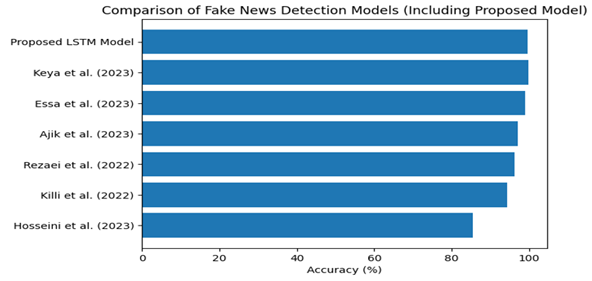
The suggested LSTM
model has a accuracy of 99.7%, which surpasses other
approaches reported in literature, such as stand-alone algorithms like LSTM
(99.18%), and combined DL models (maximum 98%). This is due to better data
pre-processing and model configuration. However, more experiments need to be
conducted to validate its performance. (Figure 1 shows comparison of model’s accuracy).
|
Figure 1
|
|
Figure 1 Comparison of Fake News Detection Models |
METHODOLOGY
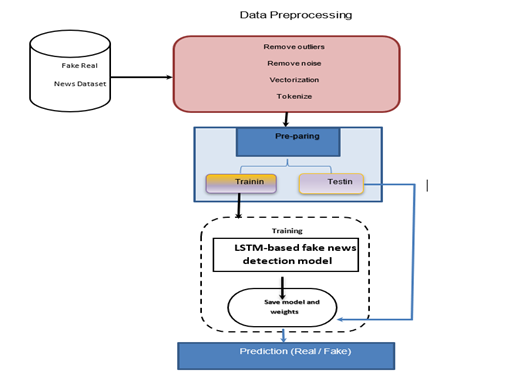
This methodology
describes how to develop a deep learning model that can be used to distinguish
between true and fake news. This model involves several stages, from data
gathering to the generation of predictions. (Figure 2 illustrate methodology process flow).
|
Figure 2
|
|
Figure 2 Methodology Process |
Data
The first step
starts with a Fake and Real News Dataset, which has categorized news articles
as real or fake. This forms the basis for the application of supervised
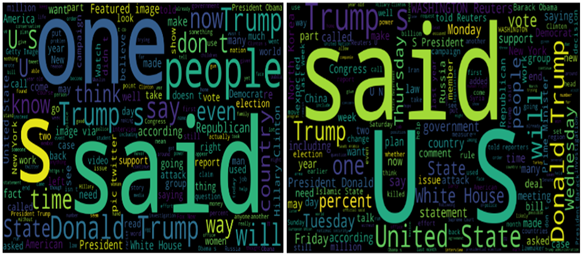
learning.(Figure 3
illustrates word cloud for fake and real data), which helps understand
most used words except stopwords.
|
Figure 3
|
|
Figure
3 Methodology Process Illustrates Word Cloud
for Fake and Real Data |
Data Preprocessing
Prior to feeding
the data into the model, there are some preprocessing techniques that are
performed for better results: Outlier Detection: Getting rid of outliers or
unnecessary data that might have a bad impact on the model. Noise Detection:
Removing any noise from the text such as unnecessary characters or symbols. Tokenization:
Splitting text into smaller units (words or tokens). Vectorization: Converting
textual data into numerical representations (e.g., TF-IDF or word embeddings)
so it can be processed by machine learning algorithms. Distribution
Train-Test Split
Dataset is split
into two subset as follows: Training Dataset: The
training dataset is used for training purposes only. Testing Dataset: Testing
dataset will be used for testing the model.
DATA ANALYSIS AND RESULTS
Model Training (LSTM-based fake news detection model)
The LSTM framework
utilized architecture that includes
Embedding, 128 neurons in the layers, and a sigmoid activation function in
classifying the data, optimizer Adam, and accuracy metric for measuring the
capability of the model.
Model Saving
After completing
the process of training, the trained model and its weights can be stored. This
means that there would be no need for the process of retraining when deploying
the model.
Prediction
At last, the saved
model is used for predictions. Preprocessing processes new input news and the
saved model decides whether the input news is real or fake.
Model Evaluation
To determine the
performance of the recommended fake news detection approach using LSTM, various
evaluation parameters have been utilized. This ensures that not only is the
model highly accurate but also highly reliable in terms of detecting fake news.
Accuracy is the parameter used to measure the correctness of the model, as
explain in equation bellow:
 (1)
(1)
Precision will be
used to evaluate the number of actual fake news detected among those predicted
by the model, , as explain in equation bellow:
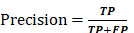 (2)
(2)
Recall indicates
the ability of the model to find out fake news, as explain in equation bellow:
 (3)
(3)
F1-Score is the
harmonic mean of the above metrics, as explain in equation bellow:
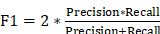 (4)
(4)
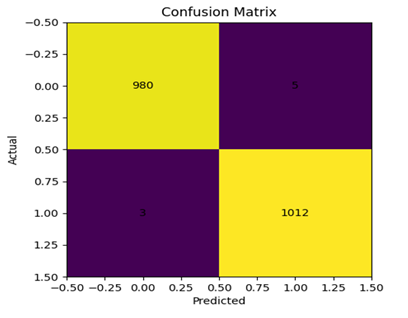
where: True
Positive = Fake News detected as Fake ,True Negative = Non-Fake News detected
as Non-Fake ,False Positive = Non-Fake News detected as Fake ,and False
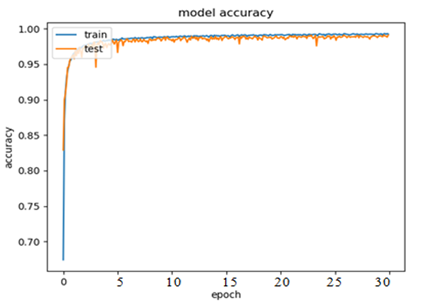
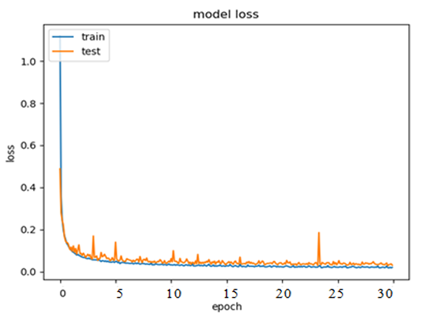
Negative = Fake News detected as non-fake. (Figure 4 explain confusion matrix), (Figure 5 show accuracy), and (Figure 6 loss function).
|
Figure 4
|
|
Figure 4 Explain Confusion Matrix. |
|
Figure 5
|
|
Figure 5 Model Accuracy. |
|
Figure 6
|
|
Figure 6 Model Loss. |
CONCLUSION AND RECOMMENDATIONS
Conclusion
This study
presented an effective approach for fake news detection using a Long Short-Term
Memory (LSTM) model. Methodology covered data preprocessing, feature
extraction, training the model, and evaluating its performance with various
metrics. As a result, the proposed approach reached very high metrics, having
99.7% accuracy, Precision: 99.49%, Recall: 99.69%, and F1-Score: 99.59% which
means it has excellent potential in recognizing the difference between fake and
genuine news. Comparison with other works shows that traditional machine
learning algorithms (SVM, Random Forest) usually provide slightly worse
accuracy from 80% to 92%, while using deep learning and hybrid methods can
increase this metric to 95%-99%. Even more complex algorithms like transformers,
ensembles, etc. provide accuracy up to 99.3%. In this case, despite the use of
simple features, our proposed LSTM-based model shows better results than most
other algorithms. Although the model demonstrates great accuracy, certain
limitations cannot be overlooked. First, performance might vary depending on
the quality and structure of the dataset used. Besides, overfitting can be
observed with more complex datasets and the use of highly sophisticated
algorithms. In addition, advanced approaches often use metadata and multimodal
features in their algorithms.
Recommendation
For future
research in this area, it is suggested to test the effectiveness of this model
on other and varied datasets, as well as include more features such as metadata
and images. Furthermore, it is advisable to consider hybrid models,
incorporating the use of transformers alongside LSTM models.
DATA AVAILABILITY
The study's
dataset is accessible to the general public on the Kaggle platform. It is
available at [https://www.kaggle.com/data-sets/clmentbisaillon/fake-and-real-news-dataset?select=Fake.csv].
The dataset
contains labeled news articles categorized as real
and fake.
All preprocessing steps applied in this study
are described in the methodology section, and the processed data can be made
available upon reasonable request.
ACKNOWLEDGMENTS
None.
REFERENCES
Ajik, E. D., Obunadike, G. N., and Echobu, F. O. (2023). Fake News Detection Using Optimized CNN and LSTM Techniques. Journal of Information Systems and Informatics, 5(3), 1044–1057. https://doi.org/10.51519/journalisi.v5i3.548
Akinyemi, B. O., Adewusi, O., and Oyebade, A. (2020). An Improved Classification Model for Fake News Detection in Social Media. International Journal of Information Technology and Computer Science, 12(1), 34–43. https://doi.org/10.5815/ijitcs.2020.01.05
Alghamdi, J., Luo, S., and Lin, Y. (2023). A Comprehensive Survey on Machine Learning Approaches for Fake News Detection. Multimedia Tools and Applications, 83(17), 51009–51067. https://doi.org/10.1007/s11042-023-17470-8
D’Ulizia, A., Caschera, M. C., Ferri, F., and Grifoni, P. (2021). Fake News Detection: A Survey of Evaluation Datasets. PeerJ Computer Science, 7. https://doi.org/10.7717/peerj-cs.518
Essa, E., Omar, K., and Alqahtani, A. (2023). Fake News Detection Based on a Hybrid BERT and LightGBM Models. Complex and Intelligent Systems, 9(6), 6581–6592. https://doi.org/10.1007/s40747-023-01098-0
Güler, G., and Gunduz, S. (2023). Deep Learning Based Fake News Detection on Social Media. International Journal of Information Security Science, 12(2), 1–21. https://doi.org/10.55859/ijiss.1231423
Haupt, M. R., Chiu, M., Chang, J., Li, Z., Cuomo, R., and Mackey, T. K. (2023). Detecting Nuance in Conspiracy Discourse: Advancing Methods in Infodemiology and Communication Science With Machine Learning and Qualitative Content Coding. PLOS ONE, 18(12). https://doi.org/10.1371/journal.pone.0295414
Hosseini, M., Sabet, A. J., He, S., and Aguiar, D. (2023). Interpretable Fake News Detection With Topic and Deep Variational Models. Online Social Networks and Media, 36, 100249. https://doi.org/10.1016/j.osnem.2023.100249
Keya, A. J., Shajeeb, H. H., Rahman, Md. S., and Mridha, M. F. (2023). FakeStack: Hierarchical Tri-BERT-CNN-LSTM Stacked Model for Effective Fake News Detection. PLOS ONE, 18(12). https://doi.org/10.1371/journal.pone.0294701
Kholiq, M. H. R., Wiranto, W., and Sihwi, S. W. (2022). News Classification Using Light Gradient Boosted Machine Algorithm. Indonesian Journal of Electrical Engineering and Computer Science, 27(1), 206–213. https://doi.org/10.11591/ijeecs.v27.i1.pp206-213
Killi, C. B. R., Balakrishnan, N., and Rao, C. S. (2022). Classification of Fake News Using Deep Learning-Based GloVE-LSTM Model. International Journal of Safety and Security Engineering, 12(5), 631–637. https://doi.org/10.18280/ijsse.120512
Pierri, F., and Ceri, S. (2019). False News on Social Media. ACM SIGMOD Record, 48(2), 18–27. https://doi.org/10.1145/3377330.3377334
Rezaei, S., Kahani, M., Behkamal, B., and Jalayer, R. (2022). Early Multi-Class Ensemble Based Fake News Detection Using Content Features. Research Square. https://doi.org/10.21203/rs.3.rs-2217954/v1
Sharma, K., Qian, F., Jiang, H., Ruchansky, N., Zhang, M., and Liu, Y. (2022). Combating Fake News: A Survey on Identification and Mitigation Techniques. arXiv. https://doi.org/10.48550/arxiv.1901.06437
Wang, Y., Wang, L., Yang, Y., and Zhang, Y. (2022). Detecting Fake News by Enhanced Text Representation With Multi-EDU-Structure Awareness. Expert Systems With Applications, 206, 117781. https://doi.org/10.1016/j.eswa.2022.117781
|
|
 This work is licensed under a: Creative Commons Attribution 4.0 International License
© DigiSecForensics 2026. All Rights Reserved.